

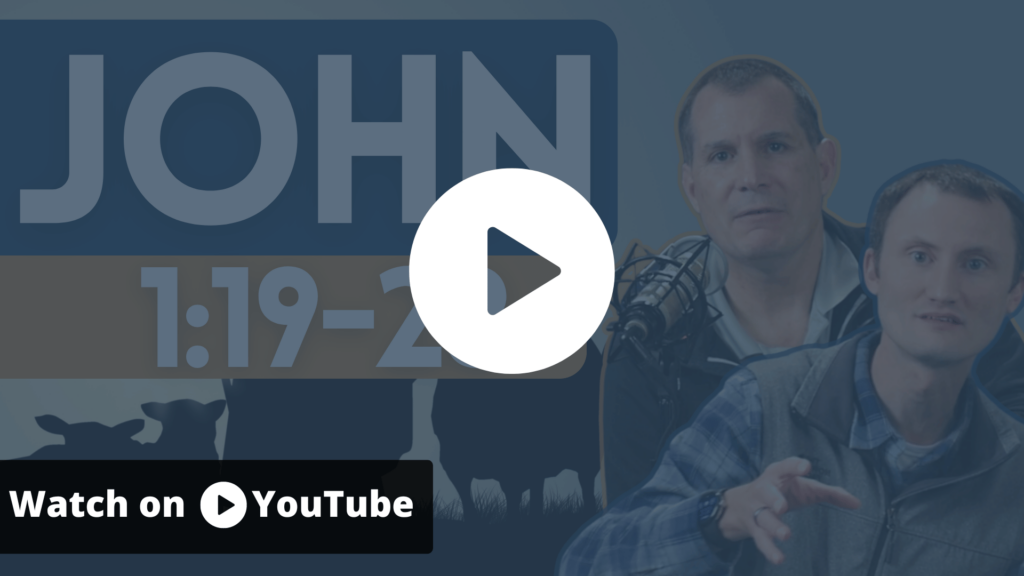
Join Clint Loveall and Michael Gewecke as they dive deep into John 1:19-28 in this insightful Bible study. In this session, they explore the role of John the Baptist as a pivotal figure in the Gospel of John, highlighting his testimony and the significance of his humility in pointing others to Christ. Discover how John’s declaration of “I am not the Messiah” sets the stage for understanding Jesus’s true identity.
Throughout the discussion, Clint and Michael unravel the theological depth of the text, emphasizing John’s role as the forerunner who prepares the way for Jesus. The conversation also touches on the importance of baptism and the witness that every believer is called to embody.
Pastor Talk Quick Links:
- Learn more about the Pastor Talk series and view our previous studies at https://pastortalk.co
- Subscribe to get the Pastor Talk episodes via podcast, email and much more! https://pastortalk.co#subscribe
- Questions or ideas? Connect with us! https://pastortalk.co#connect
- Interested in joining us for worship on Sunday at 8:50am? Join us at https://fpcspiritlake.org/stream
00:00:00:37 – 00:00:28:41
Clint Loveall
Hey everybody. Thanks for being with us as we close out the week here in the Gospel of John. Continue to work our way through the first chapter. A little bit of a change of pace. The first 18 verses really function for John as a theological underpinning. Not that John is done with theology by any stretch, but now we do begin to get into some narrative, some story, and we pick that up today in verse 19.
00:00:28:46 – 00:00:51:42
Clint Loveall
As we again meet this character that has been referenced, not really. As we meet for the first time, this character that has been referenced, John the Baptist here, not the author. So this is the description of what John is up to, what he’s been doing, what he’s been saying, and it’s an interesting place for the story to start.
00:00:51:43 – 00:01:14:01
Clint Loveall
We’ll come back to that after I read a few verses here. Starting in 19. This is the testimony given by John when the Jews sent priests and Levites from Jerusalem to ask, who are you? He confessed he did not deny it, but confessed, I am not the Messiah. And they asked him, what then are you Elijah? He said, I’m not.
00:01:14:06 – 00:01:35:55
Clint Loveall
Are you the prophet? It. He answered no. And they said, who are you? Let us have an answer for those who sent us. What do you say about yourself? He said, I’m the voice of the one crying out in the wilderness. Make straight the way of the Lord. In all of the Gospels. John the Baptist is a key figure.
00:01:35:57 – 00:02:01:34
Clint Loveall
Figure, particularly shows up early in the story. He is the Herald. He is the forerunner, the one who goes before John gives us the, I think in some ways, the crispest or the clearest conversation with John. You know, John starts with the question, are you the Messiah? That’s the first thing we hear him say. I am not the Messiah.
00:02:01:35 – 00:02:24:40
Clint Loveall
So just we we know that there was in the early church a group of people who followed John the Baptist right here. We’re going to hear in the story as it unfolds. Disciples John the Baptist has disciples, people who are with him and follow him. We know that he also has a large following of people who come out to hear him preach and get baptized.
00:02:24:45 – 00:02:49:32
Clint Loveall
And yet, the first words in this story are from John the Baptist, or I am not the Messiah. And that’s a significant point for the way that John, the author, tells this story. And as we meet this character Mark right there, there’s a sense in which the other gospels build us up to this moment. I think a little a little slower.
00:02:49:37 – 00:02:51:28
Clint Loveall
John just starts right off with it.
00:02:51:34 – 00:03:21:18
Michael Gewecke
Yeah, right. And the reason that John is so important and we’ve we’ve said this before, but now as we turn our attention to John the Baptist, the reason that he’s such an important character and just given such a prominent place so early in this story is because he is witnessing, he’s confessing. And we see this specifically. The word that we have in this translation is the testimony given by John and that that word testimony is used 37 times in the New Testament.
00:03:21:23 – 00:03:51:02
Michael Gewecke
30 of them are used in the Gospel of John. That is how important that this theme is within the whole gospel, and it’s why it is given such prominence, and why John the Baptist has given such a clear place within the story so quickly. Clint is because he is the chief testifier. He is the one with good character, with a humble attitude, shows up on day one and from the start he confesses, I’m not the Messiah.
00:03:51:07 – 00:04:13:12
Michael Gewecke
I’m not Elijah. I’m not the prophet, the one who is coming after me. We’re going to find that’s the one who’s greater. So I just want to make sure that we see right from the start that John prepares the way for Jesus. Both in terms of the people’s imagination, and he’s going to call the people to a form of repentance, in this story to come.
00:04:13:17 – 00:04:35:22
Michael Gewecke
But what we have right here is very, very clearly that John is the first character of the story, verse 19, who’s already giving us that testimony. He’s giving us that witness. He’s setting the tone of how the characters of the story are going to all, in their own individual ways, be witnesses and testimony, bringers of the gospel of Christ.
00:04:35:34 – 00:05:01:06
Clint Loveall
Scholars suggest that because we jump into this story like this, it’s an indication that the Gospel of John is written and written to people who are all already pretty familiar with John the Baptist. His message, this conflict or controversy of whether he’s the Messiah, the growing conflict with Jewish leaders, that it it makes sense if you just think about it.
00:05:01:15 – 00:05:34:35
Clint Loveall
Given that there’s no real prelude to this, there’s no explanation, given that this question is already on the forefront in the very first part of the gospel, it seems reasonable that those who are the intended receivers of this gospel are familiar with those things. And so John does this fairly comfortably. Just leaves out some details. And when that happens, we are left with the assumption that those who are reading the gospel probably already knew those details and didn’t need them.
00:05:34:48 – 00:05:58:07
Clint Loveall
There will be other places that John will fill in some gaps, but when he doesn’t, we assume it’s because those things are already known. The answer that John gives here is also wonderful. They say, well then who are you? And he answers, I’m the voice of one crying in the wilderness, make straight the way of the Lord, which is a quote from Isaiah chapter 40.
00:05:58:12 – 00:06:32:20
Clint Loveall
And one of the wonderful things about some of these quotes is that they didn’t live with a lot of expectation. It wasn’t understood that Jesus or that John knew what these things meant in the broader context. In other words, they weren’t picking, they weren’t picking verses that were well known by people and had established meanings. This a similar reality would be Jesus calling himself Son of Man, which is a fairly obscure title in the Old Testament, and not one that carried a lot of baggage with it.
00:06:32:20 – 00:06:53:02
Clint Loveall
So John says here I’m I’m the forerunner. I’m the voice that cries out in the wilderness, make straight the ways of the Lord. In other words, I’m, as you said, my God, I’m the one who testifies. I’m the one who announces, I’m the one who tells the truth about the one who is coming after me and is greater than I am.
00:06:53:07 – 00:07:07:21
Clint Loveall
And this is what gives John the Baptist his flavor, especially in this gospel, the Herald. And he has this essential role that he plays, and we jump straight into it.
00:07:07:35 – 00:07:33:34
Michael Gewecke
There’s also another introductory note that I think is pretty subtle here, and I don’t want to pass by it with us missing it in verse 20 there, when he confesses and doesn’t deny, but says, I am not the Messiah. Now, if you’ve not read the Gospel of John yet, that may just sound like a denial, but if you’ve read the Gospel of John, you might know that to come Jesus will several times make him statements.
00:07:33:34 – 00:07:53:29
Michael Gewecke
Jesus will say, I am the bread of life. I am the vine, I am Jesus repeats these. I am statements affirming who he is. It’s it’s fascinating that the very beginning of the book, one of the first words offered by the one who gives a witness is I am not. I am not the one who is going to come.
00:07:53:29 – 00:08:23:43
Michael Gewecke
And this, just as you see the richness of this text, later on, we’re going to discover that Jesus is all of the things that these human witnesses could not be for themselves. And what’s so amazing about John, I think, the telling of John the Baptist is that he is not competing for attention. He’s not looking for notoriety, he’s not seeking popularity, and he’s also not looking to be raised up to to high religious power.
00:08:23:43 – 00:08:53:36
Michael Gewecke
What simply what John wants to do is to point others to the one who represents God in flesh, to who is the one that has come to save the world, and that is the the beautiful witness that that sets off the tone. And, you know, if you’re going to think about gospel starts and you want to think about the beginning of Jesus’s story, I think most of us, Clint, we think of the Christmas story.
00:08:53:36 – 00:09:18:40
Michael Gewecke
We think of angels and shepherds, and we think of nativity scenes and all these things. But in the Gospel of John, the most important introductory character is none of these. It’s rather a person fully grown, simply recognizing Christ for who he is and giving witness to those who come asking about him, saying, this is who Jesus is. He is the Messiah.
00:09:18:45 – 00:09:24:48
Michael Gewecke
And that that is an amazing sort of opening invitation to to what’s going to follow.
00:09:24:54 – 00:10:03:34
Clint Loveall
We’ve noted this before, but the other thing that’s sort of noticeably absent in John’s gospel is, at least at this point, prophecy. All of the other gospels equate the coming of Jesus with predictions and forecasts. The closest we get here is this reference to Isaiah. But it’s fairly minimal. And so John tends to focus on the moment at hand and tells the story with a kind of current urgency.
00:10:03:34 – 00:10:27:56
Clint Loveall
And so that that’s what we have here. I’m who are you? I’m the one making straight the way of the Lord. And we don’t need, we don’t get, nor do we need a lot of reference for what that means. We continue verse 20 for the next couple verses. So they asked him they had been sent from the Pharisees and they asked him, why then are you baptizing if you’re neither the Messiah nor Elijah, nor the prophet?
00:10:28:01 – 00:10:51:59
Clint Loveall
John answered, I baptize with water. Among you stands one whom you do not know, the one who is coming after me. I’m not worthy to untie the thong of his sandal. This took place in Bethany, across the Jordan from where John was baptizing. So, here we have this reference to John being the Baptizer. We call him John the Baptist.
00:10:51:59 – 00:11:27:11
Clint Loveall
But Baptizer is probably a better translation of some of the titles, at least as they often appear in the Greek. He’s the one who baptizes in baptism. There’s history out there. You can get into it. We won’t take the time to dive deeply into it. It was not a practice that John established. It had grown in some popularity, but it wasn’t a widespread practice among the Jewish faith, though in small places, small, in certain places and in small minorities, it was practiced.
00:11:27:16 – 00:11:55:40
Clint Loveall
And here John seems to have had a great following of people who responded to it. The idea was repentance. The idea was, turning away from your sin of being washed. It had that kind of symbolism, symbolism in it. It is not inherently Christian, though. It becomes fully Christianized in the wake of the gospel and in the testimony and work of John the Baptist.
00:11:55:40 – 00:12:08:58
Clint Loveall
And really, his place in the story cements baptism as a kind of Christian ritual that ends up becoming one of the things we even call sacrament.
00:12:09:03 – 00:12:35:22
Michael Gewecke
So actually, baptism is one of the components of this that is so confusing to the religious leaders who come because we have the Pharisees. And you may know that the Pharisees represent a group within the Judean faith that was taking very seriously. The moral law, the the sort of handing down of the faith and trying to live that out in very concrete ways.
00:12:35:22 – 00:13:05:46
Michael Gewecke
So here, baptism in the Jewish tradition is certainly the Pharisees interpretation of it was connected to the end times. It was connected to everything being fulfilled. And so here, there they at this point, the story, are likely asking this as a legitimate question. There’s there’s likely not a whole lot of, sort of argument or force behind it yet on the curiosity, if you are neither the Messiah nor Elijah, nor the prophet, then why are you baptizing it?
00:13:05:51 – 00:13:31:39
Michael Gewecke
And when John answers, this is an amazing statement. I baptize with water. And one commentator makes the point of saying, this is written to almost have the force. I only baptize with water. And that is the amazing kind of witness and testimony we see in John, a kind of really unparalleled humility of a person from day one who is not striving for self.
00:13:31:39 – 00:13:56:54
Michael Gewecke
I think of someone like Peter, another example of a of a very prominent biblical character and we know, as we see Peter’s story told in the Gospels that he struggled to to hear what Jesus was saying. He often got off place, either trying to build a tabernacle for Jesus, or he was trying to, you know, gain power and privilege in the places where they were here.
00:13:56:54 – 00:14:18:21
Michael Gewecke
John the Baptist is simply out in the wilderness. And here, this place, Bethany, that we talk about, it is really an unknown place to the archeological record. So it’s a small place. It’s out in the middle of nowhere. It’s kind of off the beaten path. And even there, John is trying to set the path straight. He’s trying to proclaim the good news.
00:14:18:21 – 00:14:48:00
Michael Gewecke
He’s trying to, say to the people what they need to hear so that their hearts might be prepared to receive the Christ who is coming. I think that’s what is so amazing about how John tells this story. It’s both, on one hand, telling us that Jesus is a person who is great enough and powerful, not because he’s the Word of God taking flesh, that it’s right for someone to proclaim his arrival.
00:14:48:05 – 00:15:13:57
Michael Gewecke
On the other hand, if that isn’t done, if we aren’t baptized, if we’re not transformed and clean from the inside out, then we won’t be ready to know and to understand the story of Jesus Christ. And also, John is the kind of character who represents an ideal, or a call or a purpose for every Christian that follows Christ that, in other words, just like John was there proclaiming this.
00:15:13:57 – 00:15:35:44
Michael Gewecke
So Christians too are called to proclaim just as he gave testimony. So to we are to give testimony that. So there are many, many layers functioning in the text like this. And I think every single one of them is important because 28 verses of chapter one, we’ve yet to have the first word of Jesus that’s going to come next week, Monday.
00:15:35:49 – 00:15:50:38
Michael Gewecke
Join us for that. But up to this point, we’ve had this beautiful prolog, the theological foundation that’s been laid. Now you have the first witness to the glory of Christ, and now we’re going to see Christ himself. And John’s built that for some purpose.
00:15:50:45 – 00:16:17:56
Clint Loveall
It’s kind of a matter of perspective, but one of the things that scholars wonder about is that in this opening part of the gospel, the first few chapters, there is a kind of comparison of John and Jesus, and the speculation is that John is aware of a community that lifts John the Baptist up, perhaps, in his opinion, too highly.
00:16:17:56 – 00:17:09:32
Clint Loveall
And so while he simultaneously celebrates John’s role in the gospel, as the Herald, as the announcer, as we go through this, notice how many times John is going to say things like, I’m not the Messiah. He’s greater than I am. He must turn into more while I turn into less. That any any comparison that could be made is addressed by John, the author in the gospel to make sure that his readers understand that Jesus is in the superior role here, that John is a servant, a willing one, a knowledgeable one on an incredibly important one, but that he himself understands he is a subordinate to Jesus.
00:17:09:32 – 00:17:41:20
Clint Loveall
And that has again just led some to speculate that maybe John is aware of some questions along those lines, and he just wants to make sure he provides absolute clarification. That’s not so much a part of the text as it is with what people have wondered about the text, but you will notice that as we go through these first couple chapters, whenever John shows up, he clearly understands his relationship to Jesus to be one of underling underneath servant.
00:17:41:20 – 00:17:44:00
Clint Loveall
And that’s important in in the context.
00:17:44:02 – 00:17:55:17
Michael Gewecke
And it creates a kind of tension even within this gospel client. Because on one hand, John is such an important character because of the witness he gives. And on the other hand, the gospel writer John doesn’t want us to give John.
00:17:55:17 – 00:17:56:45
Clint Loveall
To or.
00:17:56:45 – 00:18:28:53
Michael Gewecke
Credence that he’s do either. That is a that’s a balancing act that is intended to be held in tension. And yeah, that’s absolutely purposeful. Hope that you found this conversation interesting. Hope that you might join us for the study as we continue. Indeed, next week on Mondays, we continue together. We’re going to come right into the heart of Jesus’s arrival and some of those first words from him and hope that you will be part of the continuing study as we learn, not just about the I am not that we discovered today, but the image of Jesus to come.
00:18:28:53 – 00:18:33:43
Michael Gewecke
So subscribe so you get more of that. I like this video if you found it helpful and we will see you next week.
00:18:33:48 – 00:18:34:36
Clint Loveall
Have a great weekend!