

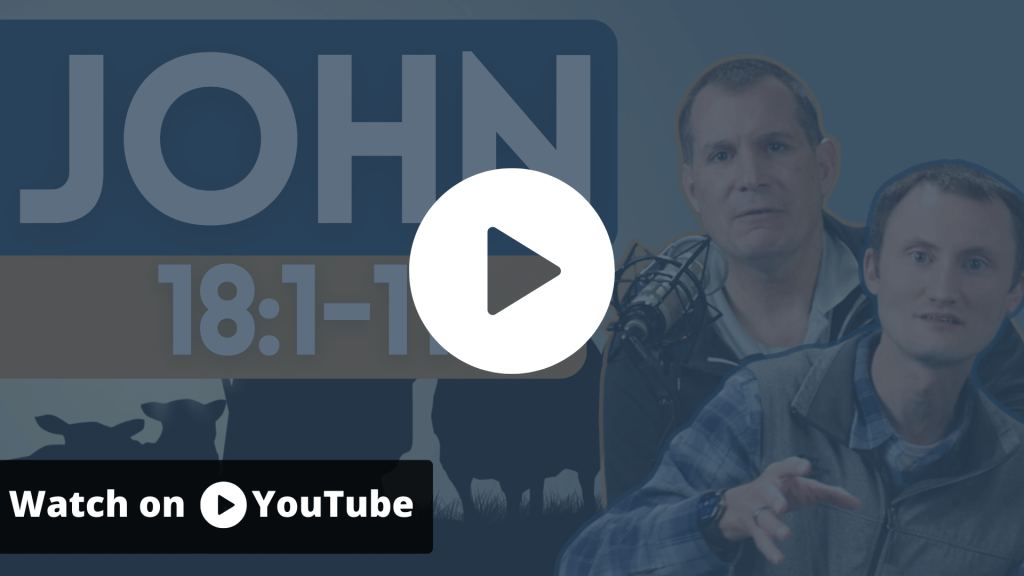
In this episode, Clint and Michael dive into the dramatic shift in John’s Gospel as Jesus moves from prayer to arrest. Unlike the other Gospels, John paints a portrait of Jesus who is entirely in control—no betrayal kiss, no surprise attack, just divine authority on full display. They unpack how Jesus steps forward, names himself with the powerful “I AM,” and causes soldiers to fall to the ground. The discussion highlights how John weaves together themes of strength, divine mission, and chosen sacrifice, challenging our assumptions about power and vulnerability. A profound and rich look at one of the most pivotal scenes in Scripture.
Pastor Talk Quick Links:
- Learn more about the Pastor Talk series and view our previous studies at https://pastortalk.co
- Subscribe to get the Pastor Talk episodes via podcast, email and much more! https://pastortalk.co#subscribe
- Questions or ideas? Connect with us! https://pastortalk.co#connect
- Interested in joining us for worship on Sunday at 8:50am? Join us at https://fpcspiritlake.org/stream
00:00:00:21 – 00:00:21:18
Clint Loveall
Hey, everybody. Welcome back. Thanks for joining us. And sorry. We’ve had a couple days off. The schedule’s been, a little bit crazy lately, but glad to be back here. And glad to have you joining us or listening in, with us as we continue through the gospel of John. And I would say, Michael, we take a pretty significant turn here.
00:00:21:23 – 00:00:47:01
Clint Loveall
As we’ve gone through some of the summary stuff that John has given us in chapter 16, and especially maybe in chapter 17, the long prayer of Jesus. I think he now takes a decidedly fixed view upon these last events and that last part of Jesus life. So we we jump right into kind of the Passion Week story.
00:00:47:02 – 00:00:55:57
Clint Loveall
You know, in other gospels, we get a little bit of a build toward that kind of typical of John. He just drops us into it in some ways.
00:00:55:57 – 00:01:04:01
Michael Gewecke
And so you might argue that it’s all been a passion week. And John, in some ways, like there’s not even necessarily need to be there.
00:01:04:10 – 00:01:30:04
Clint Loveall
So maybe mentally he doesn’t draw the same distinction as sectioning things out in that that way. But Jesus says said this prayer. He’s prayed for the disciples and the church to come after them. And then right away, John changes our focus to the betrayal and the arrest of Jesus. So, let me read, ten verses or so here, and then we’ll work our way through them.
00:01:30:09 – 00:01:57:34
Clint Loveall
After Jesus had spoken these words, he went out with his disciples across the Kidron Valley to a place where there was a garden which he and his disciples entered. Now Judas, who betrayed him, also knew the place, because Jesus often met there with his disciples. So Judas brought a detachment of soldiers together with police and from the chief priests and the Pharisees, and they came there with lanterns and torches and weapons.
00:01:57:39 – 00:02:18:31
Clint Loveall
Then Jesus, knowing all that was to happen to him, came forward and asked them, whom are you looking for? They said, Jesus of Nazareth. He replied, I am he. Judas, who betrayed him, was standing with them. When Jesus said to them, I am he. They stepped back and fell to the ground. Again he asked them, whom are you looking for?
00:02:18:36 – 00:02:38:10
Clint Loveall
And they said, Jesus of Nazareth. Jesus answered, I told you that I am he. So if you’re looking for me, let these men go. This was to fulfill the word that he had spoken. I did not lose a single one of those that you gave me. Then Simon Peter, who had a sword, drew it, and struck the high priest slave and cut off his right ear.
00:02:38:15 – 00:03:03:04
Clint Loveall
The slaves name was Malchus. Jesus said to Peter, put your sword back into the sheath. Am I not to drink the cup the father has given me? So we see a couple of things kind of typical of John’s telling of the story in. I think it interchanges in a really interesting way. Michael, first of all, Jesus, we’ve we’ve, I hope we haven’t beaten this to death.
00:03:03:09 – 00:03:31:01
Clint Loveall
But in John’s gospel, Jesus is not surprised by this moment that Jesus isn’t taken unaware. They don’t trap him. He knows what’s happening. In fact, John even gives us a sort of hint that maybe Jesus could have escaped when they first say we’re looking for Jesus and he says, I am he. And with the force of those words, which we’ll talk about in a moment.
00:03:31:06 – 00:03:55:21
Clint Loveall
They stepped back and fell to the ground. So it’s possible John is even suggesting to us that Jesus could have left if he wanted to, which seems like the kind of suggestion John would make, but typical of the telling of the Jesus story in this gospel, Jesus faces this moment with courage. Even reprimanding Peter. I’m not trying to escape.
00:03:55:21 – 00:04:12:29
Clint Loveall
I’m not trying to fight back. This is the cup the father has given me, and and I am going to drink it. And I think in some ways we see those themes that we’ve seen consistently through this book, Michael. But here they’re they’re pretty they’re on pretty sharp display.
00:04:12:34 – 00:04:39:43
Michael Gewecke
No doubt. And Clint, I think there’s only is added to your point actually, that when you look at the text here, it’s really interesting that John, in his telling you this story, wants us to know that the people who came to get Jesus are bringing soldiers along with, the, the police. And look who’s implicated in this. The chief priests, the Pharisees.
00:04:39:54 – 00:05:03:32
Michael Gewecke
I mean, there’s a really unholy alliance here. Really, Clint, because the chief priests and the Pharisees, they’re not the kind of people who get along in social conversations. There’s there’s a substantial difference between both their theological positions, but also their power positions at this time. And so the fact that we’ve got soldiers, we’ve got temple police, we’ve got chief priests, we’ve got Pharisees.
00:05:03:34 – 00:05:24:22
Michael Gewecke
John is painting a picture here that when you come to get Jesus, you come with an army. And when you when you come to get Jesus, you know that you need to come prepared and that there’s even a level of concern potentially, that displayed in sort of the the amount of this mob that’s coming. And so I just think it’s worth that.
00:05:24:28 – 00:05:25:58
Michael Gewecke
That intensifies your point.
00:05:25:58 – 00:05:43:51
Clint Loveall
Yeah. And sorry, sorry to interrupt, Michael, but I also it could be missed that those aren’t groups that work together, as you said. And and they have access to Roman soldiers because for John, anyone who stands against Jesus works together, right? I mean, we’ve seen that already.
00:05:44:04 – 00:06:15:47
Michael Gewecke
Yeah, yeah. And that’s the, I think point that we need to get to here, is this power that you’re talking about that is displayed when Jesus says, I’m here, they step back and fall to the ground when Jesus says, it is my hour or it is my time. When Jesus says that I give up my spirit. That is John portraying for us what John means to be a literal account of what is actually true, that the Son of God is allowing these things to happen.
00:06:15:52 – 00:06:50:34
Michael Gewecke
And, you know, we need to talk a little bit about the I am he part here in the second, but I just think it’s worth noting here that when the powers of the world come to put an end to the creator of the world, as John has told the story from the very beginning, the thing that those people intend to be are a show of force against Jesus will never, in this gospel, actually be a show of force that subjects the Son of God and John through this storytelling.
00:06:50:34 – 00:07:13:17
Michael Gewecke
And it’s interesting how this part of the story is going to come to an end with Peter using the sword is that ultimately, Jesus is really unmoved by the power plays of the people around him. Jesus is not interested in what Peter’s going to try to do to protect him, and he’s also not afraid of the people that come with pitchforks and torches.
00:07:13:17 – 00:07:15:18
Michael Gewecke
And that’s all happening in this story.
00:07:15:18 – 00:07:43:55
Clint Loveall
You know, to that point, Michael, I think it’s very interesting to to some extent, you know, the gospel accounts each have their own flavor in terms of the passion narrative or the the arrest narrative here. But notice what isn’t here, right? If you ask people what happens in the garden, yeah, they’re going to say something probably from one of the other gospels, most notably.
00:07:44:00 – 00:08:13:57
Clint Loveall
Well, Judas betrays him with a kiss, right? That they trap Jesus, that they have to identify him here. John. John wants us to get a different a different feel. Jesus stepped forward. Jesus came. For there’s no Judas has to point him out. There’s no we we got him trapped. Jesus offers himself. Who are you looking for? He says the first words he.
00:08:13:57 – 00:08:47:02
Clint Loveall
He puts the attention on himself. I just think that that’s such an interesting way that John tells the story, and it’s related to how John imagines, oh, not. I should be very careful with the word. Imagine how how John wants us to imagine the scene and how John understands the work of Jesus. And so Jesus, nobody needs to identify Jesus.
00:08:47:02 – 00:08:58:10
Clint Loveall
He will do it himself. And and I think that that is a characteristic of John that’s very evident here in the way he tells his story.
00:08:58:15 – 00:09:16:21
Michael Gewecke
Remember that up to this point in the story, at these pivotal moments, Jesus has been leading his disciples all along the path, revealing who he is. And every one of those junctures he has said, I am the fill in the blank. You’re right.
00:09:16:30 – 00:09:17:15
Clint Loveall
Seven times.
00:09:17:15 – 00:09:39:27
Michael Gewecke
Yeah. And within that story arc, Jesus is revealing more and more and more of who he is with these things. Whether it is, you know, I am the gate or right or I’m the light or whatever it is, Jesus is revealing the truth of another part of his nature, of his character, of his mission that he’s come to do in the world.
00:09:39:41 – 00:10:09:33
Michael Gewecke
And here we should not miss the very intentional response, which, by the way, John has given us two times. Right? I am he. And Jesus says, actually three times, because in verse eight he says, you know, I told you that I am he. So when Jesus says, I am he, that that’s our Bible translators way of summarizing that the I am that we get in Moses and the Ten Commandments and the burning bush.
00:10:09:37 – 00:10:35:54
Michael Gewecke
You know, that’s a that’s a really broad and really quick take on it. But it is safe to say that this is a pinnacle moment, that Jesus is saying this thing which has the kind of power of dropping people to their knees. And it is a kind of powerful, I am revelation statement happening at the exact time that these worldly powers think that they’re now going to take possession of Jesus.
00:10:35:54 – 00:10:57:33
Clint Loveall
I don’t want to I don’t want to repeat what you’ve just said, Michael, but I think this is a really crucial thing. So seven different times, as you mentioned, we’ve had I am the gate, I am the good Shepherd. I am the light. I am living water. Right. John has used those moments to tell us something about Jesus seven times in this gospel.
00:10:57:37 – 00:11:22:19
Clint Loveall
And and this is lost a little bit in English because we add the word he, which is implied in Greek, but in the Greek this simply says, I am so here at the end, in the garden, Jesus drops the I am something, something, something and simply says I am, which is the words that God gave Moses at the burning bush.
00:11:22:19 – 00:12:00:29
Clint Loveall
Who are you? I am, I am who I am, I am who I was. All of that is in there. I am. And at the moment of that proclamation, it carries such force, such truth, such power, that those who have come to do harm, those who have come to work against God, step back and fall down. And again, John is preaching a visual sermon here as we imagine that happening, that just with a word, I am just with the proclamation of who Jesus is.
00:12:00:34 – 00:12:29:03
Clint Loveall
Evil falls down before him. And yet he will go on to submit himself to it. This is Yeah. I don’t want to get overzealous here, Michael, but this is this is really, incredibly well-written. It’s it’s profound. And it’s a beautiful illustration of a place John has been taking us for a long time that we may not have known we were going in terms of the language.
00:12:29:07 – 00:12:58:46
Michael Gewecke
That being said, though, Clint, if we are willing to step back, pull up for just a little bit, what a weird place to put that in the narrative. I mean, I think really let’s let’s take a moment here to really name what’s happening. Jesus is revealing the extent of his mission and his identity in the display of his chosen weakness, and that that’s essential both theologically in terms of the larger Christian story.
00:12:59:00 – 00:13:03:59
Michael Gewecke
But I think it’s important in this book, as John tells this story, incredibly important.
00:13:03:59 – 00:13:17:13
Clint Loveall
And to add to that, in also protecting the disciples. Yeah. Standing in to say that I’m they’re going to be the first people I deliver. Leave them alone. Let them go. You take me instead.
00:13:17:18 – 00:13:39:07
Michael Gewecke
That is, I think, one of the things, too, that we need to make sure that we catch is that ultimately, we don’t get a lot of prophecy fulfilled kind of stuff in John. That’s not really John’s tack, but here it is fascinating, this idea that Jesus is now giving credit in verse nine for fulfilling the word he had spoken.
00:13:39:07 – 00:13:59:31
Michael Gewecke
I did not lose a single one of those you gave me, which, by the way, just came in the prayer that we just made it through together. It’s fascinating that the very thing that Jesus is displaying in his weakness, which is the strength to save his disciples, is the same good news that the earliest church would have received when they read this story, Clint?
00:13:59:33 – 00:14:31:15
Michael Gewecke
Because in their case, the early church might not have needed to use their imagination to come up with the idea of people with weapons and lanterns coming for them. I mean, that was a lived reality in the earliest church. And so I think for disciples and for believers in Jesus Christ, hearing that Jesus himself was strong in the moment and that in fact, Jesus had words to offer Peter about his turning to violence, right?
00:14:31:15 – 00:14:57:33
Michael Gewecke
This idea? Well, maybe we just need to carry a sword to defend ourselves. It’s built into the story that Jesus doesn’t need a guard for him to exercise his power. No, no, Jesus’s power is fully contained and and given by God the Father. He can do what he will. And I think that this has real implications for real people in their faith that this isn’t just a story about what happened.
00:14:57:37 – 00:15:05:57
Michael Gewecke
John is has something to say. The people who are experiencing the difficulties and tumults of faith in their real lives.
00:15:06:01 – 00:15:27:59
Clint Loveall
I want to just make one more note. And it comes from the last verse or the last sentence here. Jesus says, am I not to drink the cup that the father has given me? Again, the other three gospels. If someone would know this story from the other three gospels, all three of them have a reference to a cup.
00:15:27:59 – 00:16:00:49
Clint Loveall
But what is Jesus asking, father, if this cup could pass from me? Yeah, nevertheless, I will drink it, right? That doesn’t work for John. That Jesus says I’m going to drink the cup. There’s no could I have another cup or a different cup, or can I not take this cup? John has a different approach to telling the story, and in it, the only thing that Jesus has to say about the cup that is going to be his is I.
00:16:00:49 – 00:16:13:44
Clint Loveall
I’m ready to take it. And I think again, that that helps you see the unique nuances of John, as opposed to maybe the other stories which which with which we’re probably more familiar in some cases.
00:16:13:58 – 00:16:47:16
Michael Gewecke
Yeah. Because just like how John will include these stories in different orders than what we have in the other three gospels. John, here, we’ve said this in many ways and many times. And like you said at the start of this conversation, we want to be careful we don’t over repeat things, but there’s a kind of pastoral sentiment to the way that this gospel is written in that each story has in it not just an account of what happened, but a a sermon, a lesson, a teaching, an invitation even, I think would be fair.
00:16:47:16 – 00:17:26:18
Michael Gewecke
And as we look here to the start of a pivotal week in the life of Jesus, not not even a week, the the last days here in Jesus’s story, we’re already seeing the theological richness of the cup being combined with the power being combined with the self revelation. Jesus is not, in other words, waiting for the cross to have all of this come together every single moment along the journey, including the weakest moment from an outsider’s perspective, is in the hands of John, a sign of the strength of the person at the center of that week.
00:17:26:27 – 00:17:29:15
Clint Loveall
And and a, I would add, a chosen moment.
00:17:29:20 – 00:17:47:48
Michael Gewecke
Yeah. Absolutely. All right. Well, thank you for choosing to click on watch it or listen to this episode. We’re glad to have you with us at this study. It’s been interesting. Or this conversation give this a like it helps others find it. And of course subscribe as we get into some of this amazing material here at the end of John and until tomorrow, be blessed.
00:17:47:49 – 00:17:48:28
Clint Loveall
Thank you all.