

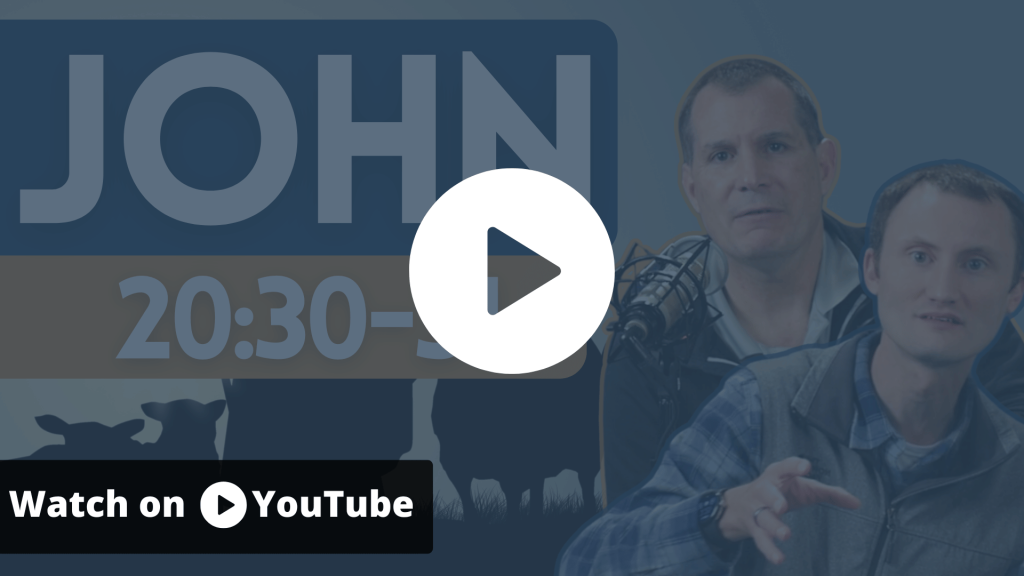
In today’s study, we reflect on the powerful conclusion of John chapter 20, where the Gospel writer steps out from behind the story to tell us directly why he wrote his account. Clint and Michael explore how John’s purpose wasn’t to offer a comprehensive biography of Jesus, but to give readers enough to believe and find life in Christ’s name. They discuss how this moment acts like a bridge between the resurrection appearances and what follows, and why this seemingly “ending” moment is so deeply personal to every believer. This passage reminds us that faith isn’t just about seeing miracles—it’s about trusting the story handed down for our sake.
Pastor Talk Quick Links:
- Learn more about the Pastor Talk series and view our previous studies at https://pastortalk.co
- Subscribe to get the Pastor Talk episodes via podcast, email and much more! https://pastortalk.co#subscribe
- Questions or ideas? Connect with us! https://pastortalk.co#connect
- Interested in joining us for worship on Sunday at 8:50am? Join us at https://fpcspiritlake.org/stream
00:00:00:43 – 00:00:28:04
Clint Loveall
Hey, everybody. Thanks for joining us. Thanks for starting the week with us. We continue through the Gospel of John. Today we wrap up chapter 20, the, essentially the resurrection chapter, the appearances. And we hit a kind of an interesting moment as we get to the end of the chapter here, verse 30 and 31. They have the feel of almost ending the book, and we can talk about that.
00:00:28:09 – 00:00:48:40
Clint Loveall
Let me let me just read these couple verses, then we’ll talk it through. Now, Jesus did many other signs in the presence of his disciples which are not written in this book, but these are written so that you may come to believe that Jesus is the Messiah, the Son of God, and that through believing you may have life in his name.
00:00:48:45 – 00:01:13:39
Clint Loveall
I don’t know, Michael. You. I think you probably, more up on John’s scholarship than I am. I don’t know if anyone makes the case that this was an ending, but it it certainly has a kind of wrap up feel to it. And, there are two off the top of my head. I suppose there’s a couple of explanations for this one.
00:01:13:44 – 00:01:45:36
Clint Loveall
Maybe I don’t. I’m not aware that anyone makes a case that chapter 21 shows up later. I don’t know if that has been argued seriously, but I do think chapter 21 functions differently in the text. It’s much more of a transition kind of chapter. And therefore that makes me wonder if this is a kind of bridge between what we would call the Easter stories, and then what would happen in the aftermath of Jesus being resurrected.
00:01:45:36 – 00:02:12:25
Clint Loveall
And, a little bit of a little bit of time elapsing from Easter Day itself. I don’t know exactly why that would be, other than there is a sort of summery feel to this. John says, you know, we could have written all kinds of other stuff, but I wrote what you’ve read so that you may come to believe that Jesus is the Messiah, and that you may have life in his name.
00:02:12:34 – 00:02:22:52
Clint Loveall
That has a almost a conclusion feel to it that ends up not being the case. And I think it makes it, interesting and it makes it stand out a little bit.
00:02:22:57 – 00:02:41:49
Michael Gewecke
Yeah. I think that there could be some interesting conversations related to the composition of the book. I do think there are scholarly arguments that this is the original conclusion of the book. That shouldn’t be surprising to you. If you read something like The Gospel of Mark, where we have a very similar conversation about the ending of that gospel.
00:02:41:51 – 00:03:07:37
Michael Gewecke
But needless to say, I think that generally when we’re reading the Gospels, it’s better to read them as they’ve been delivered to us rather than trying to reconstruct something that was there. And I think what’s fascinating to me about the ordering and construction of this is that there is a kind of pause here, almost a giving us, the reader, a breath because we’ve had all of these encounters.
00:03:07:37 – 00:03:46:23
Michael Gewecke
Of course, Jesus died, and now here we’ve had these accounts of resurrection and various personalities and characters of the story and how they responded. And then we get to this, that this admission that there were so many other signs done but not included here. And, and that’s an explicit way, I think, that John is reaching out to us through the pages here, and John is inviting us to see that it isn’t that we’re looking for a comprehensive picture of everything done, but rather a big enough picture that we can find ourself in it.
00:03:46:28 – 00:04:11:42
Michael Gewecke
And this is really important. We shouldn’t miss this. This book is all about and find the name, verse 31, Jesus, who is the Messiah, the Son of God, but not just for some kind of so you know him, some kind of name dropping reason? No, for the purpose that through believing you may have life in his at this.
00:04:11:47 – 00:04:39:32
Michael Gewecke
This is a absolutely beautiful and masterstroke way of taking these many disparate themes, which have all been pointed together this whole time and saying, look, this is this is the point. You have Jesus who said and taught these things, prayed these prayers. Jesus, who gave his life and did so on purpose, Jesus, who was resurrected and was seen by all of these who believed even with their doubts and in their moments of disbelief.
00:04:39:39 – 00:05:09:03
Michael Gewecke
All of this is true. But the reason I’m telling you this isn’t so that you’ve got a little bit more information than your head. It’s so that you might come for your own life to be changed by the belief that has grown inside. This is the admission that comes explicitly of the purpose of this gospel. It helps us to understand the reason this stuff came before is to fulfill the purpose of belief today, and the book continues to serve that.
00:05:09:03 – 00:05:27:59
Michael Gewecke
Now there’s going to be more to come, and we’ll talk about that as we move forward in the study. I don’t think Clint, that there’s something quite this explicit in the other gospels, and I really appreciate John for the way that this both ties together the themes in this book, but also it has a way of teaching us what the gospel is.
00:05:27:59 – 00:05:33:25
Michael Gewecke
I in gospel by the capital G, like the telling of Jesus, is like, this is an important part of that.
00:05:33:30 – 00:06:03:21
Clint Loveall
Yeah, I would agree. You know, the dedication of Luke comes to mind where Luke says, like many others, I’ve undertaken to provide the history and to provide an account. But but I think that functions very differently than John’s words here. And what’s interesting is we’ve said this before and that John is not only a great storyteller, a great writer, but some of his words move into preaching.
00:06:03:21 – 00:06:24:34
Clint Loveall
And and I think we get to some of that here. Michael, first of all, we have this word signs. And we’ve seen there are seven major signs in John. But the idea of signs is important to John. What do signs do? They point us toward a reality. So what do the signs in this book and the signs in the presence of the disciples?
00:06:24:34 – 00:06:51:52
Clint Loveall
Do they point us toward Jesus? It’s also fascinating, and I think you’re right. I don’t know of another gospel that makes this claim. There are other things which are not written. In other words, particularly if John is in fact a later gospel. If John is written after some of the other gospels. It’s fascinating that John is not claiming here some comprehensive story.
00:06:51:57 – 00:07:15:52
Clint Loveall
He may be aware of other stories that he didn’t include in the book and and in saying that, he’s essentially saying there are lots of other things that could be written. But what I’ve written, I’ve written to the purpose that you will know Jesus as the Messiah and believe in him, that you would have life. Well, what is that?
00:07:15:52 – 00:07:40:47
Clint Loveall
That’s a sermon. That’s the intention of preaching. I’ve done what I’ve done. I’ve said what I’ve said. I’ve put it in the way that I’ve organized it so that you could get a look and see the signs of Jesus in such a way that you now understand not only who he is, but that you would believe in him to the result of having life in his name.
00:07:40:52 – 00:08:05:40
Clint Loveall
I, I, I think you and I have said this before, it, I am, I am, jealous. I, you know, I’m I’m extremely jealous of how much meaning John can here put in two verses. This is this is dense. It’s a wonderful summary there. This is just, I don’t know what it is. Again, we could argue.
00:08:05:42 – 00:08:30:18
Clint Loveall
Was it originally the end of the book? Was it not? I I’m sure those arguments are out there, but whatever is its function, it works really well to highlight John’s intention and to say, I haven’t said everything. I haven’t given you the last words on Jesus, but the words that I have given you should be enough for you to know something of who he is and have enough to believe in his name.
00:08:30:18 – 00:08:38:01
Clint Loveall
And I think that’s, I think we see John, the preacher here as much as we see John the author.
00:08:38:06 – 00:09:00:07
Michael Gewecke
I’m gonna take this a little bit devotional here, and I don’t think I would argue this. This isn’t a hell. I’d be willing to die. But Clint, there’s an argument to be made either. At least be interesting to see where it would lead us to say that while a verse like John 316 gets remembered for obvious reasons, right?
00:09:00:07 – 00:09:27:18
Michael Gewecke
That the summation of the gospel, I think what this verse, what these two verses together do for us has a kind of power that rivals that. And in this, what I mean by it is this is John telling us that this thing that has been written is not some kind of theoretical belief statement, that this isn’t some kind of boil it all down into one thing.
00:09:27:32 – 00:09:53:04
Michael Gewecke
And then if you can memorize that and you can, you know, quote that, that the Super Bowl, then everything is good. What what’s amazing about this and why I think is powerful if we’re willing and able to see it, is John is telling us that the signs that Jesus gives us, which are by definition very hard to get Ahold of, impossible actually to to grab and to not let go of.
00:09:53:16 – 00:10:27:05
Michael Gewecke
They’re mysterious. They they’re words that, that reach into meaning that we can’t quite yet pin down. The amazing thing is that all of these signs, together with all of the witnesses from the woman at the well, all the way from Nicodemus to all of these characters who’ve been essential and we’ve seen coming in and out of the story with various levels of understanding and faith, all of them are helping us to see that at the end of the day, this is an invitation for us that that these are signs that Jesus is truly who he said he was.
00:10:27:05 – 00:11:05:47
Michael Gewecke
And if that’s true, then everything changes in our life. The whole meaning making structure becomes defined by those signs of who Jesus is, as opposed to whatever else the world may say about him. That he was a lunatic, that he was a power hungry person, that he was just a great moralistic teacher. Whatever story you might receive about Jesus or believe about Jesus, John’s contention here is that if you understand what has been written in this book, the stories of Jesus carefully selected to help us see that truth, then you will understand that there’s more than what meets the eye in this man.
00:11:05:47 – 00:11:33:56
Michael Gewecke
That, in fact, John wants us to know that Jesus Christ is, as we have said, the son of God is not just the Messiah. He’s not just the one who would come as Savior. He’s the Son of God. That’s the ridiculous, life world changing transformation that is on offer. If we understand what John is doing here at that, I think there’s something amazing about how this is included as a kind of explicit thesis statement for us to get our minds around.
00:11:34:01 – 00:11:58:23
Clint Loveall
I think it’s natural for modern Christians, whatever modern means for Christians of our day who live in an era where people can argue Bible online and they can look up videos to think of the historicity of the texts, we we have those arguments, right. Did that happen? Did it happen in this order? Why is it out of order in John as opposed to the other ones?
00:11:58:28 – 00:12:40:59
Clint Loveall
Why does this one say that it happened this way, but that one says maybe it was a different way. And I think our temptation is the idea that these these original authors sat down to write history. They wanted to write what happened. And I do think that’s true. They understood themselves to be passing along true information. But I think in as John pulls back the curtain there, it also here it also says something more than that, that John is considering the impact of his stories, that John’s purpose is not just, hey, let me tell you what happened when Jesus was alive.
00:12:41:04 – 00:13:11:24
Clint Loveall
It’s he let me make the case that Jesus is the Messiah, the Son of God. And hopefully you come to believe that and you come to live in that truth. And I think it’s I think it’s helpful for us to imagine that, as John at least sat down to record these stories and to to compile this information and to write what he probably didn’t realize would become what it’s become in our Bible.
00:13:11:29 – 00:13:43:06
Clint Loveall
He does so with the idea of not just giving stories that may or may not be entirely accurate and historical and etc. though we like to believe they are. But he says what will help people believe? And I think it colors the intentions of how gospels get written and why John does this. And I just there’s something about this insight into John’s process.
00:13:43:06 – 00:14:10:37
Clint Loveall
And John’s goal that I think is, is really helpful. I think it’s really inspiring. Maybe it raises troubling questions for some, but I, I don’t find it troubling at all. In fact, I find it very humbling. I find it very admirable and and I think it I think it gives, a nice framework to explain and understand the gospel we’ve been working our way through.
00:14:10:42 – 00:14:34:39
Michael Gewecke
This book is intended for disciples of every generation. This is this is to answer the question that we had in the last study. And if you missed the study where we were talking about Thomas, certainly jump back and watch that. But I want to make sure that what you see this Jesus says in verse 29 to Thomas, have you believe because you’ve seen me.
00:14:34:39 – 00:15:00:34
Michael Gewecke
Blessed are those who have not seen and yet have come to believe. Well, how are those who’ve not seen going to come to believe? Today’s the answer to that. It’s because John wanted there to be an account so that everything you needed of all of the thousands of of books that could have been written, there’s going to be one that would include the things that were necessary for you to come to see Jesus for who he actually is.
00:15:00:48 – 00:15:18:06
Michael Gewecke
Nicodemus came to Jesus at night. Ultimately, it was a whole journey for him to come to see the truth of who Jesus was. How do you come to Jesus? At what point of your life do you come to Jesus and what do you see when you come to Jesus? John wants to be your conversation partner. I’d say even more than that.
00:15:18:10 – 00:15:38:06
Michael Gewecke
He wants to first give you a revelation, a word you wouldn’t have got to on your own. John wants to share something that was true about Jesus that is actually more than just true about a human. It’s actually so true as to encompass the very creation of the universe as we saw this book starting in John one one.
00:15:38:06 – 00:16:17:51
Michael Gewecke
So I friends, I just think this is an amazing recognition of the fact that there would come disciples who would need one day to know the basic truth of who Jesus was, to be able to be transformed for their belief, to define their life and John set out with the explicit purpose. He tells us this is what he intended to do was to give us enough for us to be people of faith generation later, and here we are once again, talking about these words, talking about what John had to say, because John has delivered on that promise.
00:16:17:51 – 00:16:37:10
Michael Gewecke
And I think it’s just worth pointing out that there’s a kind of amazing gift in John being explicit about that intention, which is not a thing we always get from the scriptures writ large. We’re often reading other people’s mail. I think this is an opportunity for us to see. This mail was intended for us.
00:16:37:15 – 00:17:15:31
Clint Loveall
There is an interesting there’s an interesting takeaway here, Michael. Let’s say for a moment that that group of scholars that suggests this seems like the place where John may have originally ended, and that chapter 21 is a little bit later, if you’re going to make that case and there’s arguments you could use. But let’s let’s imagine for a minute that that is true, that verse 31 is the place where John initially thinks I’m done writing.
00:17:15:35 – 00:17:44:31
Clint Loveall
Well, that makes the last words of Jesus in this book, blessed are those who have not seen and yet come to believe that is, in its own way, an incredibly powerful place for John to end his story. And and to whatever extent we can kind of feel out. John centuries later in a different culture and different world, it feels like something he would do.
00:17:44:31 – 00:18:07:53
Clint Loveall
It feels like the kind of last word that John might offer. And then this little footnote and by the way, there’s so much more I could tell you, but I’ve told you enough that you can make your choice. And I, you know, maybe, maybe I can try to look into the pros and cons of that idea between now and tomorrow.
00:18:07:53 – 00:18:15:56
Clint Loveall
But it feels like a place that John could have ended and it would work pretty well.
00:18:16:01 – 00:18:16:37
Michael Gewecke
Well, you.
00:18:16:39 – 00:18:27:31
Clint Loveall
Know, having said that, I love chapter 21. Yeah, some wonderful, beautiful, amazing stuff in it. But this wouldn’t have been a bad place if this was the original ending. It’s a good one.
00:18:27:35 – 00:18:45:27
Michael Gewecke
That that’s we’re going to move on in this study. I hope you’ll subscribe to stay part of that conversation. We’re going to discover a lot of leadership themes. There’s a lot of restoration and forgiveness to come. All of that’s really important in the story. I think it fits beautifully. Everything in this gospel is told in a way that has impact and meaning.
00:18:45:41 – 00:19:03:37
Michael Gewecke
I just want to make it clear Jesus has something to say to you. I think you’re right to point that out, Clint. The red letters. Bless those who’ve not seen and yet have come to believe that’s written to you. And in case we might miss it, John is telling us in the very next two verses. No, really, this is for you.
00:19:03:37 – 00:19:03:50
Michael Gewecke
Yeah.
00:19:03:50 – 00:19:04:58
Clint Loveall
You have enough to do that?
00:19:04:58 – 00:19:05:36
Michael Gewecke
Yeah. Exactly.
00:19:05:36 – 00:19:07:08
Clint Loveall
Enough. You can make that choice.
00:19:07:19 – 00:19:25:40
Michael Gewecke
So here we are. I realize sometimes we we find a small section and we pause on it, but I think this is one worth pausing. Also, I hope that it’s been encouraging to you. Like this video. If it has, it helps others find it in their own study. And I sincerely hope you’ll can continue with us as we conclude this book with the last chapter.
00:19:25:53 – 00:19:27:57
Michael Gewecke
But we’re glad to be together as we continue.