

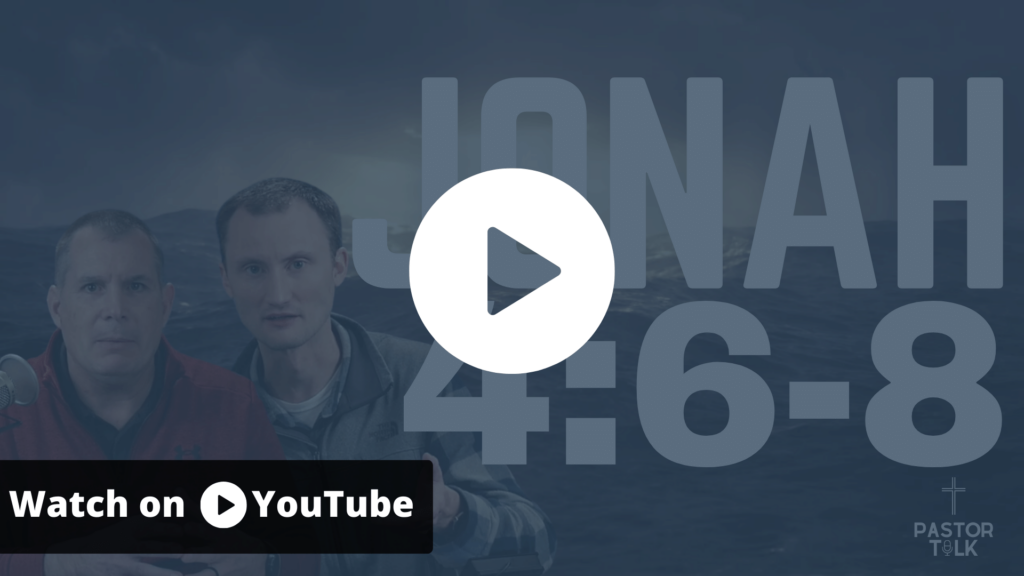
Today Clint Loveall and Michael Gewecke as they delve into the depths of the book of Jonah. Explore the themes of deliverance, discomfort, and the transformative power of God’s love. Discover the subtle role of nature throughout the story and its impact on Jonah’s mindset. Uncover the complex relationship between life and death, and the dissatisfaction that lingers in Jonah’s heart.
Pastor Talk Quick Links:
- Learn more about the Pastor Talk series and view our previous studies at https://pastortalk.co
- Subscribe to get the Pastor Talk episodes via podcast, email and much more! https://pastortalk.co#subscribe
- Questions or ideas? Connect with us! https://pastortalk.co#connect
- Interested in joining us for worship on Sunday at 8:50am? Join us at https://fpcspiritlake.org/stream
00:00:00:10 – 00:00:26:04
Clint Loveall
Hey everybody, thanks for joining us on this Wednesday. As we move closer and closer to the end of the book of Jonah, we we are, approaching or I would say we are in kind of the climax of the book. we are about halfway through chapter four, which is itself kind of divided into three sections. Jonah gives, somewhat of a speech at the beginning of chapter four.
00:00:26:09 – 00:00:52:22
Clint Loveall
God will kind of get the last word and and have a similar speech that we’ll look at tomorrow. And today we get a kind of story in between those two pieces, a narrative piece in between the two, sort of, speech like pieces, or at least the, the vocalization from the characters and just to, to, just to make the transition where we left off.
00:00:52:22 – 00:01:17:20
Clint Loveall
Nineveh has been saved. Jonah is unhappy about it. It displeased him, tells us that writing the text. And he has prayed to God now with the request, I please take my life. In other words, I’d rather die than live. And he then, in the aftermath of God asking a question or giving him a warning about his anger, Jonah has left.
00:01:17:20 – 00:01:36:21
Clint Loveall
He walked out of God’s presence, and he moves to the east of the city. And he watches from a booth that he makes. And then today I, I it’s hard to say, Michael, that there’s a strangest part of the book of Jonah. Right. But it it could be this. I mean, this would be in the running. So let me read it for you.
00:01:36:21 – 00:02:00:39
Clint Loveall
Then we’ll come back and see what we can find in it. The Lord God appointed a bush and made it come up over Jonah to give shade over his head, to save him from his discomfort. So Jonah was very happy about the bush, but when dawn came up the next day, God appointed a worm that attack the bush so that it withered when the sun rose, God prepared a sultry east.
00:02:00:39 – 00:02:33:45
Clint Loveall
When and the sun beat down upon Jonah’s head so that he was faint and he asked that he might die. He said, it is better for me to die than to live. So Jonah has made this booth. He’s sitting over overlooking the city. The implication, I think, is that he’s still hoping he might see Nineveh destroyed. He, he, at this point, I think, is hopeful that maybe they’ll go back to their old ways and God will still decide to punish them.
00:02:33:55 – 00:02:56:10
Clint Loveall
That’s not explicitly in the text, but I think that’s kind of the feeling, the vibe we get here. And then God shows up and does something kind for Jonah. He does this bush or this tree, this thing that grows up and provides shade for Jonah. And the text here is interesting. It says Jonah was very happy. The word here is exceeding.
00:02:56:15 – 00:03:19:57
Clint Loveall
Jonah was exceedingly happy about the bush, and to my knowledge, this is the first time, maybe, that the word happy has been used of Jonah in this text. In this story. I don’t think that’s an emotion we’ve seen from him. And then the next day, God sends a worm that attacks and withers the bush, and the heat beats down upon Jonah.
00:03:19:57 – 00:03:43:57
Clint Loveall
Even with God’s help, a sultry east wind. And Jonah then again ends up back where he was in the earlier part of this chapter. It would be better for me to die than to live. A really strange kind of episode here, Michael. It’s not. It’s not an obviously clear devotional reading. It’s not an even an obviously clear part of the story.
00:03:44:02 – 00:03:57:48
Clint Loveall
I think it’s subtle here, but I think what the author is trying to set us up for, maybe even tell us in this text, is something about Jonah’s continuing mindset here before we get the last words from God.
00:03:58:03 – 00:04:18:03
Michael Gewecke
Yeah, absolutely. I think that’s where I would also end up here at the end of this telling. I would maybe want to make a connection a little bit earlier before we get there, though. And Jonah’s an interesting book because when you talk about Jonah, the first thing that comes to people mind is, oh, he got swallowed by a whale.
00:04:18:03 – 00:04:42:10
Michael Gewecke
He got swallowed by a fish. It’s that fantastical element of the story. But, Clint, when we look at this and we see here that God makes a shade grow over his head, this idea that it grows up almost even while he’s sitting there, it’s the sense of the text that is a fantastical, natural thing that doesn’t happen in our everyday experience.
00:04:42:10 – 00:05:05:34
Michael Gewecke
And if we weren’t so captivated with the great fish, we might also see the fantastical nature of this component of the story. And make no mistake, both of them are natural forces. They’re both things in the world one a creature and the other a plant. And in both cases, God appoints or God sends, or God utilizes these natural things to accomplish an end of the story.
00:05:05:34 – 00:05:29:52
Michael Gewecke
And so if you connect this with chapter two, where we have Jonah saved from death by this great fish, here we have Jonah, who is saved from discomfort. He is in fact made, as you said, exceedingly happy, because he is given the comfort of being sheltered from this this day. And God, in that once again gives Jonah a kind of blessing.
00:05:29:52 – 00:05:58:40
Michael Gewecke
God gives Jonah a kind of providential level of care. And here Jonah is grateful. Jonah has received this, and there’s real joy or happiness is what the text says. And I think what is fascinating about this lesson is in both cases, when God does good for Jonah, when God spares Jonah something in the first case, his life in the water, and now maybe his comfort, or maybe his ability to sit in wait in this place.
00:05:58:51 – 00:06:22:01
Michael Gewecke
When God does this and Jonah responds as we see what we would like to be a positive response, we have a beautiful Psalm in chapter two. And now we have this moment when Jonah is really happy, and we’d love for it to stay there, except for the fact that the end of chapter two and Jonah goes into the city, he goes just a little part way in to preach this good news.
00:06:22:06 – 00:06:56:25
Michael Gewecke
And ultimately it’s a half hearted sermon at best here. Two it is not long until when that shelter goes away, immediately this happy, very reluctant prophet turns into a very angry, reluctant prophet. I think that’s what makes this story so fascinating. In both cases, God does good things for Jonah. We would hope to see a positive response. And and each time I think it is clear, by the way, that this is written, that the reader is to feel that something is still wanting.
00:06:56:25 – 00:07:12:56
Michael Gewecke
And at this part of the equation, we’ve not read through the end, and there’s going to be some, answers to some of the questions, and there’s going to be more questions opened up with no answers. But even at this point, I think we’re a little dissatisfied with Jonah’s response to what’s happened here.
00:07:13:01 – 00:07:33:39
Clint Loveall
And that I think, Michael, that’s part of two very interesting things about this book. And if we could dial out a minute and just think about the book as a whole, this complex, it’s really wonderfully written. But there are two things here that we are subtle, so I’m not sure that we’d catch them. One, I think you’re pointing us to.
00:07:33:39 – 00:08:01:51
Clint Loveall
And that is the kind of role of nature in this book. You know it. It is a wind. This is the second time that God sends a wind. It is the wind in the second chapter that keeps Jonah from running away, that threatens the boat here, then it is a great fish that’s sent to deliver him here. It’s a bush that brings him comfort, and a worm that is appointed to attack the bush.
00:08:01:51 – 00:08:48:57
Clint Loveall
And then God sends again a wind. And so the forces of nature are both natural and supernatural. In in this book are at God’s command, and some are for Jonah’s deliverance and even briefly, his comfort. But all of us, all of them collectively seem pointed at teaching Jonah something, or at least moving Jonah toward his call. Not simply we might find at the end of the book to preaching in evil, which is happened, but to consider what it means that God is God, even to the people that Jonah doesn’t care for even, and I mean that literally.
00:08:48:57 – 00:09:13:01
Clint Loveall
He does not care for them. He doesn’t care about them. And and so I think the role of the natural world woven throughout this story is really interesting. And I think, you know, because of the fish, because of some of the bigger elements of the story, it can get missed. But I think it’s there. I think it’s subtle, but I think it’s really interesting.
00:09:13:06 – 00:09:33:09
Michael Gewecke
I think, Clint, that we have to also recognize that the topic and theme of death has been interwoven throughout this story, because ultimately, God has saved Jonah from death when he brings this great fish. After Jesus thrown into the sea. And then now Jonah is even in this very text, it’s better for me to die than to live.
00:09:33:09 – 00:10:01:15
Michael Gewecke
So once again, we have Jonah wishing for death. But you know, the fascinating thing? God sent Jonah to the city of about to spare them. From what? From death? From destruction? From the natural outcome of the judgment for their actions. And ultimately, when the people there repent, we suddenly see this transformation we’ve already discussed in previous study how God is moved by that because of God’s relational love for the people.
00:10:01:15 – 00:10:29:24
Michael Gewecke
So ultimately, here we have a question. And now God’s going to ask a question, in the following verse, since I’m not going to rush to that question, but I think a question that we, as the reader, have at this point is ultimately how can all of these people experience these same actions happening to Jonah thus far? The sailors on the boat who are moved by the storm, and then ultimately the calming of that storm?
00:10:29:29 – 00:10:52:01
Michael Gewecke
How do the Ninevites who receive this proclamation from Jonah, how do they hear it? And from the greatest to the least, how are they transformed? And here Jonah swallowed, but he’s delivered from death by this great fish. Now God miraculously provides him a kind of cover that we can only imagine in our mind what that would look like in the natural world.
00:10:52:15 – 00:11:17:40
Michael Gewecke
And then Jonah also watches that bush destroyed with the same kind of speed that we could only describe as miraculous. And Jonah is the only one who seems to not be moved by God’s action in these places. He seems to be the only one who’s steadfast in his resilient commitment to be stuck on his own mindset, to be stuck into his own vain.
00:11:17:45 – 00:11:47:45
Michael Gewecke
And ultimately, I think we’re going to discover that the question that hangs over this book is going to be led by God’s own question, and I’ll leave that to to later. But I think we should just be very, very clear here that what Jonah has experienced transforms everyone in the story. And now in this moment, this pivotal moment where God provides for him again, even as Jonah, I, in my mind’s eye, see waiting expectantly, hopefully on the city.
00:11:47:45 – 00:12:06:11
Michael Gewecke
Now he’s kind of like he’s at the nosebleeds in the baseball stadium and he’s trying to look down on the boat. Are is the meteorites going to come? Is God going to send the judgment? And ultimately, when God gives him comfort and then that comfort is taken from him and that’s all it is. It’s not his life. It’s his comfort.
00:12:06:16 – 00:12:31:26
Michael Gewecke
Jonah immediately moves to this last line. It’s better for me to die than to live. And the question is ultimately, what is the cost of life? Well, what is the the difference in value between having one’s life taken from them and God graciously giving someone life and even extending one’s life? And here Jonah is decidedly sits on one side of that equation.
00:12:31:26 – 00:13:02:04
Clint Loveall
So I think that’s the second theme. That’s subtle, but fascinating in this book is the relationship of life and death, not exclusively because you have the sailors, you have the Ninevites, but front and center. That’s a question that hangs over Jonah, who in the early part of the story runs away from what God asks him to do and is willing to be thrown into the sea rather than to be turned around by God.
00:13:02:09 – 00:13:31:19
Clint Loveall
When the soldiers say, what should we do to live? He says, throw me into the sea and again, the text doesn’t specifically say this to us, but I think the clear message is Jonah’s willing to drowned so he doesn’t have to go to Nineveh. He’s willing to lose his life in the water so that he doesn’t have to take a risk that God might find a way to redeem these people.
00:13:31:24 – 00:14:03:20
Clint Loveall
And when that happens, he now sits overlooking the city. And again, after a moment of comfort. Now, as soon as adversity comes, as soon as difficulty comes, he says again that I might die and notice at no point and this is not unusual, I think, in the in the Scripture. But at no point here, this Jonah show, a move toward taking his own life.
00:14:03:25 – 00:14:24:18
Clint Loveall
It’s the recognition that he wishes he wasn’t alive, that he thinks nothingness would be better than his life. And and you could ask him, you know, it’s it’s better for me to die than live. Why, Jonah? And the message is simple. I. I don’t want to live in a world where God is good and invite. And some of that is on me.
00:14:24:21 – 00:14:43:18
Clint Loveall
Some of that is is the result of what I did. That’s why I didn’t want to come here. He said it yesterday that that’s why I said I wouldn’t come, that’s why I flee. I tried to flee to Tarshish because you are gracious and I know you’d find a way to deliver these people. And I didn’t want to be a part of that.
00:14:43:22 – 00:15:17:40
Clint Loveall
And now that he lives in a world where God’s love has been shown to people that he hates, he doesn’t want to be there. And it’s it’s surprisingly dark. Michael, this is, This is I think the fourth chapter of Jonah is really, several years ago. I think probably most of our listeners are familiar with this. There was a VeggieTales movie that came out about Jonah, and when I saw the previews, my first thought was literally, I wonder what they do with chapter four.
00:15:17:40 – 00:15:40:55
Clint Loveall
Yeah, because if you leave chapter four off, it’s it’s a pretty good story, right? Jonah shows up, he preaches. Okay, it doesn’t appear that he works very hard. He walks one day. He says five words, but God sees it. God responds, and the city is saved. This is the chapter in my mind that truly takes us into the depths.
00:15:40:55 – 00:16:01:55
Clint Loveall
This is where we encounter some darkness that lives in Jonah’s heart. I think, you know, by extension, some darkness that can live in all of our hearts. And I think this is this is the for for me, this is the chapter that is most interesting. But I think it’s it’s also most telling and most troubling.
00:16:02:00 – 00:16:22:19
Michael Gewecke
So I think that this is also a book that has a lot to teach us. Towards your point, that you could read Jonah in the first three chapters and you could decide in those first three chapters. All right. Jonah’s reluctant. We know that he doesn’t want to do this. Right. But you could read it. And at the end of chapter three, you could say.
00:16:22:24 – 00:16:24:17
Clint Loveall
But it all worked out.
00:16:24:18 – 00:16:37:22
Michael Gewecke
Yeah, but the message is preached that people respond. Jonah’s probably not the happiest, but he’s probably seen big God. Good God, gracious God, you know, he received grace.
00:16:37:31 – 00:16:41:16
Clint Loveall
Now he sees it for other people. Maybe he’ll come on board sooner or later.
00:16:41:31 – 00:16:44:04
Michael Gewecke
I mean, there might be a reasonable interpretation up to that.
00:16:44:09 – 00:16:45:41
Clint Loveall
This is the chapter that does it.
00:16:45:43 – 00:17:09:28
Michael Gewecke
Yeah. And I think that this is also a testament to why when we read Scripture, we need to be far more careful in our study of it than what we are tempted to do. Because ultimately, when you remember the Jonah and the whale or Jonah and the great fish part of Sunday School, that’s the part of the story you’re most likely to remember as an adult.
00:17:09:28 – 00:17:52:55
Michael Gewecke
But as a Christian, as someone studying scripture with us, I just really want you to recognize here with us that in this chapter, all that came before is now being re-envisioned in light of this particular encounter with God, let me say it more simply. This stands to teach us about Jonah’s motivations going all the way back to the start of the story, because the question that this book is going to leave us with, I’m not going to give to you here until we finish it out together, but it’s going to call us to ask, what is Jonah’s heart at the end of this story, and has it changed throughout the whole up to this point,
00:17:53:00 – 00:18:09:12
Michael Gewecke
we might be able to make a case that there’s been some movement in Jonah’s character. He certainly did go part of the way into a city that he went the opposite way from in the beginning, at the end of Jonah. Clint, I think you’re gonna have a hard time making that case that Jonah has actually been changed in the story.
00:18:09:12 – 00:18:38:46
Michael Gewecke
And here what you have is a moment of God’s providence, a moment where God cares for Jonah. This is what is so challenging. God shows Jonah the same amount of grace that he showed the Ninevites. It’s an undeserved gift in both cases, and in this case, Jonah’s exceedingly glad for it until he says it’s not even worth me living because this has been taken away from me, this gift has been taken away.
00:18:38:51 – 00:19:03:29
Michael Gewecke
And ultimately the the dark shadow that hangs over that is, it seems that Jonah doesn’t afford the same understanding of God’s grace to his enemy. It seems that he doesn’t understand that he stands under the same gracious God as these people, that he wishes death upon, and that is this very dark cloud sort of rolling over us here at the end of this book.
00:19:03:34 – 00:19:23:08
Clint Loveall
Yeah, I think many of us from Sunday school classes or sermons or just a casual reading of the book of Jonah, we have this idea that Jonah is a little bit crusty. You know, he he doesn’t want to do what God wants him to do. And it’s just kind of a lesson about, you know, do the right thing and obey God.
00:19:23:13 – 00:20:01:43
Clint Loveall
But when you when you really consider what we read here, that Jonah wants to die rather than see his enemies live, that that’s a dark place to be, that that that is a that’s a sin, sin sick soul. that is someone who doesn’t understand grace even as a recipient of it. And I think ultimately, as Jonah, the book of Jonah starts asking us those questions.
00:20:01:48 – 00:20:33:16
Clint Loveall
That’s when it’s most powerful. Also when it’s, you know, most personal and certainly when it’s maybe most troubling. But I think the story is crafted. You know, again, the author of this book has done a masterful job of hiding some of Jonah’s true feelings from us. We knew if you were reading this book, okay, you knew Jonah had some issues, but I don’t think until you see Jonah sitting on the hill here and hearing him complain, I knew you’d be good to these people.
00:20:33:28 – 00:21:06:47
Clint Loveall
I please take my life now. It’s too much. I can’t bear it. I think it’s only in this last part of the story that you see the depth of the kind of things that Jonah is struggling with. And I think, you know, that’s very telling. It’s it’s well-written. And I think it moves us toward the conclusion that we’ll begin to look at tomorrow as we start asking what all these things mean in regard to what is this story ultimately about, and what does it ask of the reader?
00:21:06:52 – 00:21:25:03
Michael Gewecke
This story might start as a kind of milk chocolate story, easy to read, tastes good. You get to the end. And this is a very bitter dark chocolate story. It’s got a bite to it. And I think that there’s actually a lot of complexity and depth to it. So don’t miss the ending here. There’s going to be a couple days of summary.
00:21:25:08 – 00:21:41:43
Michael Gewecke
I think there’s going to be a lot that we can process what this both means in the book itself and how it applies to us. Certainly if this has been helpful, interesting, challenging for you, give this video a like if you’re on YouTube, it helps others find it in their own study. We would love to have you subscribe so you can be with us in studies like this and certainly go to the comments.
00:21:41:43 – 00:21:47:36
Michael Gewecke
Let us know if you have questions, thoughts and we look forward to seeing you all for our next live study tomorrow at 2:00.
00:21:47:40 – 00:21:48:27
Clint Loveall
Thanks everybody.