
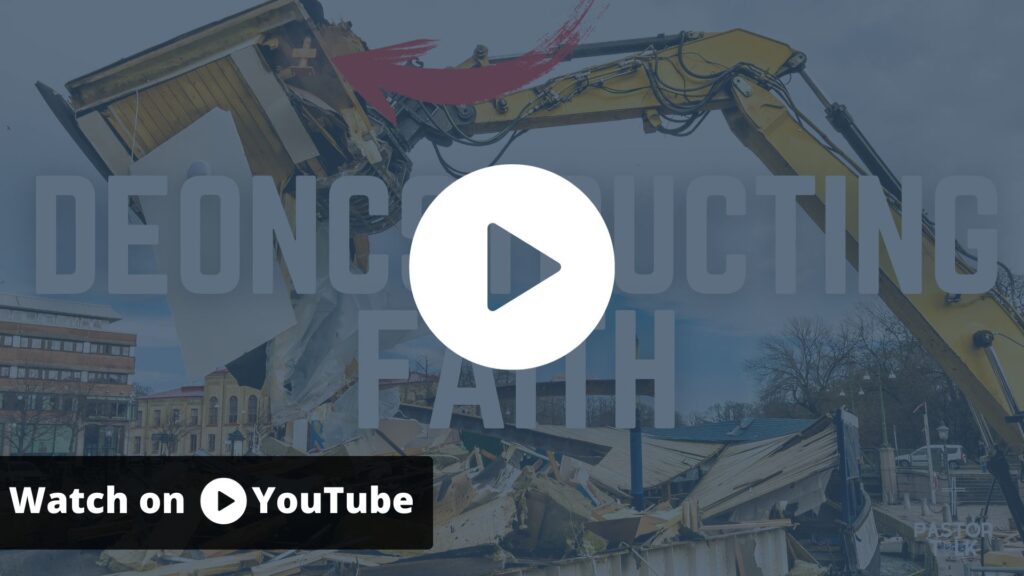
In this episode of the Passenger Talk podcast, Clint Loveall and Michael Gewecke discuss the rising phenomenon of deconstruction within the Christian faith. They explore the concept of deconstruction, its public nature on platforms like YouTube, and the reasons behind it. They also examine how this movement impacts different generations and church communities. Join the conversation as they delve into the complexities of deconstruction and its implications for the faithful Christian witness.
Feel free to share this with anyone who you think might be interested in growing deeper in their faith and Christian discipleship.
Pastor Talk Quick Links:
- Learn more about the Pastor Talk series and view our previous studies at https://pastortalk.co
- Subscribe to get the Pastor Talk episodes via podcast, email and much more! https://pastortalk.co#subscribe
- Questions or ideas? Connect with us! https://pastortalk.co#connect
- Interested in joining us for worship on Sunday at 8:50am? Join us at https://fpcspiritlake.org/stream
Watch, Listen, & Read the Full Transcript
00:00:00:10 – 00:00:26:01
Clint Loveall
Hey, everybody. Welcome back to the Passenger Talk podcast. Been a while. A few changes that we wanted to make you aware of. In the past, we had tried to keep up regularly with weekly series, and we may still do that once in a while. But what we anticipate this season, at least for the foreseeable future, is to do something monthly and to kind of pick a topic that we think might be of interest.
00:00:26:02 – 00:00:48:00
Clint Loveall
Maybe it will be a current issue or contextual issue here in the church. Maybe it will be something in the broader community that we see. Maybe it will be something historic. We’ll try to mix it up. We’d actually love to hear from you if you have suggestions to kind of treat this a little bit more like a teaching scenario or a classroom setting almost.
00:00:48:00 – 00:01:18:45
Clint Loveall
But to try to provide a library of things, of topics of of information that we think hopefully could be helpful to you and that we hope will be relevant to you as well. So this is the first of those attempts as we kick off for our latest season of podcasting. Grateful that you would give it a chance. Like I said, we would love to hear from you if you have ideas, if there are things you would like for us to maybe do a podcast on, we’d love to accommodate that.
00:01:18:45 – 00:01:22:09
Clint Loveall
So let us know and we’ll do our best to respond.
00:01:22:13 – 00:01:44:29
Michael Gewecke
Today we’re going to kick it off with a topic that I suspect either you’ve heard of before and it’s been a thing that is pique your interest or I think on the alternative side, this may be brand new for you, and it probably depends upon, you know, where you get your news and where you’re engaged in different online conversations.
00:01:44:29 – 00:02:36:19
Michael Gewecke
But really, since 2020, really the beginning of 2020, there’s been a rise, a market rise in the conversations surrounding what people are calling deconstruction. And if you have not been part of that conversation, will pause quickly to sort of give you a sense of what we understand that to mean. Largely, people have been talking about engaging their faith in new ways and discovering along that engagement, often paired with a lot of frustration, often paired with some sense of hypocrisy or an awareness of bad faith within the religion Christians have been talking about, especially in online spaces, a growing sense of needing to deconstruct or take away substantial parts of their faith with the idea that
00:02:36:19 – 00:03:09:48
Michael Gewecke
they might sort of cobble together or find a different expression of faith. And I think most often what people mean by that is non-Christian. So I think that sometimes people may be mean that they are discovering a new form or branch of the Christian faith, but I think largely I’ve understood it to be sort of deconstructing their Christian faith, which might lead to a more broad, nonspecific faith or kind of a non faith in the broadest sense.
00:03:09:48 – 00:03:39:33
Michael Gewecke
And so in the midst of those conversations of people exploring that online, there’s been several even YouTube channels and several specific places where people have gathered around this idea of deconstructing. And more and more and more, there’s kind of this call of people saying, you know, they had become uncomfortable with their faith. They feel like there’s things that they need to discharge from their faith and, you know, we’ve had some thoughts about that and wanted to explore that.
00:03:39:37 – 00:04:27:19
Clint Loveall
So for the last decade or so, the fastest growing religious group has been what is called the nuns, not Catholic women in black and white dresses. No n. E. S people who affiliate with no religious group. And we tend to think that those are people who were never religious. But this movement, I think, is a kind of charting of people who began as Christian in in many cases, most cases at some point were probably fairly serious about being Christian, in many cases were extremely serious about being Christian and have now made their way largely into that group called the Nuns.
00:04:27:19 – 00:04:56:53
Clint Loveall
They’ve now kind of dis affiliated themselves not only with their church, but with the broader Christian faith and this term deconstruction has been used as an umbrella to cover those experiences. And I think, Michael, as I understand it, and I think you have a better handle on it than I do, but as I understand it, one of the one of the particular points of deconstruction is that it has tended to be public.
00:04:56:58 – 00:05:45:32
Clint Loveall
It’s not simply someone who doesn’t come to church and decides, I’m not doing that anymore, though I’m sure that’s out there largely, this has coincided with the age of social media in which a person either charts their movement or they discuss their movement. If you would, and I don’t know that I recommend this, but if you would go onto YouTube and type in deconstruction, you would find hundreds and hundreds and hundreds of videos from Christian artists to former pastors to very serious Christian media personalities, to people that no one knows, just ordinary, you and me, kind of people who have felt the need to sort of chart their own experience with leaving the faith as
00:05:45:32 – 00:06:09:25
Clint Loveall
well. And there’s a sense in which this kind of thing has always happened. It’s it’s always been a part of the church experience. But as I see it, this is different in the sense that it is more public. And because it’s more public, it it seems to be growing. It seems to be catching on in certain circles within the church.
00:06:09:30 – 00:06:20:24
Clint Loveall
It went from a thing in even in those circles, from a thing you would really never heard of to now a thing that it seems like you hear about near constantly. Is that fair?
00:06:20:25 – 00:06:58:06
Michael Gewecke
I think it’s fair. And I think that there’s also this tendency within the church and maybe naturally to vary to have very high temperatures as it relates to this conversation, I don’t think that people come to this with a significant amount of nuance because for a lot of Christian communities, this is watching people who have been deeply affected by the faith, whose lives have been lived within the faith, saying that they have identified the core attributes of the faith that make it impossible for them to be Christian anymore.
00:06:58:06 – 00:07:29:07
Michael Gewecke
And I think that there are a variety of responses depending upon where you are. So, you know, we are in the the mainline Presbyterian tradition and in our place, I think that we are experiencing a form of deconstruction. But interestingly, I don’t think it comes with all of that language. I think there are post-COVID, especially many, many statistically relevant numbers about people who are no longer coming back into the doors of their churches.
00:07:29:07 – 00:07:56:18
Michael Gewecke
And that’s for a lot of different reasons. By the way, some of that is simply health changes. Some of that is life station changes, some of that is the changes within their church leadership or ways of ordering and structuring things. There’s lots of reasons for it. But as those people may have fallen out of the church, they may have also lost some of the meaning that went with that experience, the meaning of worship and studying with other folks.
00:07:56:18 – 00:08:31:26
Michael Gewecke
And in the midst of that, they might find themselves moving closer and closer to that non camp. Well, that is in many ways a kind of deconstruction, but not the public deconstruction that that you’re talking about that I think is largely more rooted inside the evangelical or conservative church context in which folks are often reflecting theologically, often even reflecting on their own personal anecdotal experience sometimes of leadership situations that went very wrong, abuses within the church that were covered up, and that hypocrisies of the church that they’ve seen and can no longer really live with as part of their faith expression.
00:08:31:40 – 00:08:51:45
Michael Gewecke
And then there’s also some of the deeper theology of God conversations, so and so on and so on. I don’t want to overburden that conversation, but I do want to say that for the more evangelical or conservative Christians, I think that this isn’t a thing happening quietly in the night. It’s not people who have left the building that just aren’t coming back and the wondering where have they gone?
00:08:51:57 – 00:09:27:01
Michael Gewecke
This is people who are very publicly saying in public squares that the faith that I thought was the only faith is the faith that must be discarded for me to live my life in the most healthy, whole way possible. And and so naturally, those Christian communities are often, I think, responding with a great and high degree of concern and oftentimes, unfortunately, judgment and even ridicule and I think that it’s worth sort of trying to step back from those conversations.
00:09:27:02 – 00:09:48:02
Michael Gewecke
I think it’s worth trying to look at what’s happening here. What would a Christian see in this process that people are describing? How does it really move beyond a historic Christian experience if it does? And then how do we respond to that within the faithful Christian witness of today?
00:09:48:07 – 00:10:29:20
Clint Loveall
One of the very interesting statistical findings, post-COVID, has been that in many surveys, many people’s attempt to figure out what is exactly happening in the church. The group that is leaving at the highest rate are older members, 60 and up, in many case post-retirement Christians who found themselves drifting in COVID and now simply moved on to something else and sort of had a moment where they said, I don’t feel compelled to go back to church.
00:10:29:20 – 00:10:56:24
Clint Loveall
It’s not that important to me. They may or may not consider themselves still Christian in some nominal sense, but they don’t feel the need to affiliate themselves with Christianity as a whole or with any particular expression of it. Now, I while I do think that’s part of deconstruction, Michael, and I don’t think this is surprising that older generation has not broadcast it in the same way.
00:10:56:38 – 00:10:59:20
Clint Loveall
They’ve not tended to go to YouTube and make videos.
00:10:59:31 – 00:10:59:51
Michael Gewecke
Right.
00:11:00:03 – 00:11:37:25
Clint Loveall
Rationalizing their experience and sharing their experience. They’ve just they’ve just left that. They just went on and did something else and unfortunately, we’re not hearing much of their story. But the movement part of this has tended to be younger and as you alluded to, it has tended to be more conservative. And by that I mean it tends to be grounded in the conservative evangelical church in there may be some explanations to that.
00:11:37:30 – 00:12:11:44
Clint Loveall
You know, again, maybe in the mainline church, people just drift off and don’t feel the need to say much about it. Some of those people are giving their experiences as well. But what makes this, I think, particularly interesting, and I do think unique, is that by and large, this movement is comprised of people who were very committed to very moderately and even extremely conservative expression, sins of the faith.
00:12:11:49 – 00:12:40:09
Clint Loveall
And so if they’re on the right edge, it’s not as if they’re just saying, Oh, you know what, I don’t fit as a Baptist anymore. I’ll try Presbyterian or I’ll try Lutheran. They’re feeling compelled to skip over all that and find the exit door in some public fashion. And I think that makes this very interesting because that has not typically been a thing that we’ve seen.
00:12:40:13 – 00:12:48:22
Clint Loveall
It may have happened, but it’s much more public and much more visible. And I think that gives this a unique flavor in the moment we’re in.
00:12:48:27 – 00:13:19:21
Michael Gewecke
So let’s look at this through a more historical lens just very briefly, because obviously changing churches has happened for as long as church has existed. Right. And this throughout the entire 20th century, 19th and 20th centuries, couples would marry, you would have a Presbyterian and an Episcopalian, or you’d have a Lutheran and a methodist. And this story happened hundreds of thousands, millions of times where couples would navigate that together.
00:13:19:21 – 00:13:42:09
Michael Gewecke
They would go to this church. Maybe they would both go to a different denomination and then in a way that the path of their Christian faith looked institutional. It just looked like shifting from one place to another. And Clint, I don’t want to just breeze by that for some couples, for some people that felt like deconstruction. It felt like I grew up.
00:13:42:11 – 00:14:06:48
Michael Gewecke
My family has been Methodist for the last four generations, and now we’re going to a Presbyterian church because my spouse was this or that. And for them there were real doctrinal or theological reasons for why that felt like they were deconstructing one part of their life. So that they could enable another part. But that wasn’t for them a process of destroying or breaking down their faith.
00:14:06:48 – 00:14:40:24
Michael Gewecke
It was a process of uncomfortable, both shifting to allow for other priorities. And I think that what makes this conversation truly unique is that many of these folks who are talking about deconstruction are doing so not from the frame of, well, I’m shifting from the Baptist Church to the Assemblies of God church, because I think that their expression of the Holy Spirit makes more sense in light of my lived experience, or they’re not saying, you know, I think that the church that I grew up in had some abuses in it.
00:14:40:24 – 00:15:01:44
Michael Gewecke
And so I think that there’s another Christian church that maybe has done a better job of hedging for that, and I can still live out my faith. No, what they’re saying is that the core foundation of what they experience Christianity to be is flawed because of fill in the blank and the reasons for that would be almost as often as unique as the voices themselves.
00:15:01:44 – 00:15:20:40
Michael Gewecke
So I think there’s probably some consistent things. I think I’ve heard a lot of hypocrisy, I’ve heard a lot of judgmental ism. These are things that people express and say, you know, Christians say this, but they do this, or Christians are supposed to be people of love, but they actually are people who pounce on others and judge them and box them in.
00:15:20:54 – 00:15:50:43
Michael Gewecke
You know that these are often things I’ve heard. To whatever extent that’s true. I think that that is different from that historic movement because it’s ultimately individuals saying, Now I’m just shifting into a different branch of the church, but saying, I don’t think that at the core the church is what the church claims to be. And then therefore they often find themselves in a religious place.
00:15:50:43 – 00:16:06:28
Michael Gewecke
They find themselves with some of the morals and character of Christianity being something that they think matters to themselves, but they don’t find the language or the scriptures or the community to any longer be a place where that can be formed and grown and challenged.
00:16:06:39 – 00:16:35:47
Clint Loveall
Yeah, I think to some extent, at least for a lot of those folks, Michael, they feel that the foundation crumbles. It may be a path that is at first marked by disappointments with leadership or stances. The church has taken, things the church has said, but I think many of those folks find themselves in a place where they say, I simply don’t believe these things to be true about Jesus Christ anymore.
00:16:35:47 – 00:17:04:04
Clint Loveall
I no longer consider myself able to call myself Christian. And it and there certainly is a connection to that because our experience as Christian is often lived out in a Christian community. And dissatisfaction with that community is always a challenge to our discipleship. But I think for a lot of these people, as I understand it, they have torn through those layers.
00:17:04:04 – 00:17:34:26
Clint Loveall
And at the core found that they simply no longer accept whatever it is that the fundamental or foundational doctrines they were taught me. And so they move on to either nothing, I think in most cases, possibly some combination of various things, or just the idea of I’m going to go on and be a good person, but I no longer need that because I no longer believe that.
00:17:34:36 – 00:18:02:29
Clint Loveall
And I think maybe that’s one of the characteristics of this idea of deconstruction or this movement of deconstruction is the idea of moving past something that, you know, whenever we make those decisions, right, we hope that we’re doing the right thing. We believe we’re doing the right thing. So it I don’t think it always comes across as, again, occasionally it does, but I think for many of those folks, there is a sense of I no longer need that that’s behind me.
00:18:02:29 – 00:18:34:19
Clint Loveall
I’m done with it and I’m moving on to something better in the sense of not untrue, not untrustworthy, that I found to be lacking. So I’m going to look for what’s next. And some of them do it aggressively and some of them do it, you know, negatively and veer with anger. But I think far more often they say I had some good experiences, but when I sorted it all out and I.
00:18:34:28 – 00:18:58:19
Clint Loveall
Right. Watch the videos and I read the books and I really sat down and thought about it, it it just didn’t feel true to me anymore. And I want to be clear that the sadness of that statement is that in many cases, if not most, those were people who deeply believed that at one time or at least thought that they did, I would say did most likely.
00:18:58:24 – 00:19:17:31
Clint Loveall
And that does give this this is this is not just marginal people falling out of church. I mean, marginal church members falling out of church. That’s always happened. I think the painful loss in this is different.
00:19:17:36 – 00:19:54:37
Michael Gewecke
And I think that this puts us at a crossroads. I think at this point in the conversation, we all collectively choose. And by the way, I think that churches and institutions and individuals have made both of these choices depending upon their situation and their propensity. We could choose on one hand to make examples of these folks. We can choose to lift them up as objects of judgment and and harsh language and say, Yeah, you never believed all along or say that you folks are, you know, good riddance, hope it works well for you.
00:19:54:37 – 00:20:22:28
Michael Gewecke
And the other side, you know, there is a kind of judgmental, painful kind of response in churches that say, you know, that we we in the pain of you leaving are going to lash that out on you. And I think on the other hand, and I think a very difficult path to take, but an important one, I would argue, would be to ask how have we come to a place where people are finding community with one another?
00:20:22:33 – 00:20:46:35
Michael Gewecke
And that community is rooted in the idea of the church not being what it said it was. What is it that they’re responding to? Because every Sunday that we go gather together in our sanctuaries, we are we’re calling upon the truth of Jesus Christ. We’re calling upon God’s work in the world. This this new kingdom, as Jesus proclaims it.
00:20:46:35 – 00:21:09:07
Michael Gewecke
And I think the church, every time we return to that, we’re called to return once again to the heart of what is the gospel. And that means we need to be open to where we’ve missed the gospel, where we’ve included things that are important to us, but maybe not central. Or we have told people that this is a thing that is central.
00:21:09:07 – 00:21:33:18
Michael Gewecke
And then as we’ve gone along the way, we’ve fallen away from that and we’ve not been reflective or asked the question, why is that the case? And this is rooted for me deeply in the reformed sense of truth. Reformed people have said for as long as we have existed that all truth is God’s truth. And now ultimately we as humans, by our natures, get it wrong.
00:21:33:18 – 00:21:55:04
Michael Gewecke
We miss it. And so we bring to our faith a built in humility, or we should bring to our faith a built in humility. And in the midst of that, the reformed voice would say, you know, if folks are leaving the church and saying, I have to deconstruct my faith because of fill in the blank, we might want to ask the question, what is that?
00:21:55:04 – 00:22:17:22
Michael Gewecke
Fill in the blank. What are they talking about? Is that an accurate account of what we have said or what we believe this? Does this differ from the core of the gospel or have we missed the mark? Has the church in some ways missed the core of our proclamation? And surely it’s not all of anything. Surely it’s not that the church has been all wrong or that people have all misunderstood it.
00:22:17:27 – 00:22:28:54
Michael Gewecke
But if we aren’t humble enough to admit that the church itself may have some stake in how people are expressing these experiences, then we’re not hearing these people. And I think it’s important that we do so.
00:22:28:58 – 00:23:08:33
Clint Loveall
Yeah, it’s definitely a moment to listen to the stories of those who feel either hurt or abandoned or simply let down by the church. By their expectation, those who feel that they didn’t experience in the church a kind of life giving story, that they ultimately found something that didn’t resonate with their lives in their experience and I do think it matters, Michael, and I don’t mean this to be in any way, shape or form a kind of slings and arrows at the evangelical church.
00:23:08:37 – 00:23:33:19
Clint Loveall
But I do think because reformed Christians have sort of lived with that idea of we always reform me, right, that we’re always trying to figure out where we were in there. We we know because of our ideas of sin that there’s no way we have it. All right. And so at our best, we’re trying to be open to guidance and adjustment along the way.
00:23:33:19 – 00:23:57:59
Clint Loveall
We are we’re constantly working on our understanding of faith. I do think in some ways the evangelical church has had a different approach where they have tried to kind of lock down some doctrine on scripture and in in other areas of the church’s life and say, this is what we mean and this is what we’ve always meant and will always mean.
00:23:57:59 – 00:24:25:30
Clint Loveall
And I think they’ve been and I don’t mean this as a criticism, I just think it makes sense. They have been more rigid, so there’s been less room to ask questions. So in an Internet age where people have more access to information, there’s more stuff out there. They find themselves confronted with things they didn’t know more often. I didn’t know that was in the Bible.
00:24:25:39 – 00:24:57:02
Clint Loveall
I didn’t know the church had said that one time. I didn’t know this happened. I didn’t know that happened. It’s it’s very hard in this day and age to keep that information compartmentalized. And as people begin to interact with. What do you mean? There are places in the Bible that seem to contradict each other. And how could this have been written and this has been written by the same person and those questions that were never really out on the table in those traditions, some of those traditions.
00:24:57:07 – 00:25:24:23
Clint Loveall
Now these these folks are finding deeply disturbing. I think that’s less true in our branch of the faith. It happens, certainly, but I think we’ve been with that idea that all truth is God’s truth. I’ve been I think we’ve been a little more inclined to put our cards on the table and say, well, we don’t know. And I do think that helps us in a moment like this.
00:25:24:23 – 00:25:49:42
Clint Loveall
And I hope that our approach might be helpful to some of the folks who might be struggling in these areas, though, again, it’s not that they’re finding another nest, it’s that they’re leaving entirely. And so we’ll see if that remains true. But I think the reform approach to being church may have something significant to offer in a moment like this for people who are struggling.
00:25:49:53 – 00:26:17:21
Michael Gewecke
Yeah, I agree completely. And I think that this is actually an opportunity to talk again about the importance of not just listening to other people, but listening to other traditions, because I want to make it clear, I think the church church writ large, the church with the capital C, Catholic Church, the whole Church of Jesus Christ, it is in many ways in a form of institutional crisis right now.
00:26:17:25 – 00:26:56:47
Michael Gewecke
And the interesting thing is I don’t think that that crisis looks the same in every branch of the church. I think that the the mainline certainly reformed church is struggling with a crisis of apathy, a kind of crisis of dissolving from its foundation and sort of falling under its own weight. I think that what we uncover with this movement towards deconstruction is a far more active kind of deconstruction, where folks are actually quite viscerally repelled by the Christian tradition.
00:26:56:47 – 00:27:24:29
Michael Gewecke
And they have learned some things, they’ve seen some things, and they say, I can no longer find the faith are a valuable or helpful guide to my life where maybe some people in the mainline are also finding themselves there. I think more often there is just the faith has become less relevant for people in those circles and they’ve just slowly over time drifted away from it without the kind of crisis event that people are describing.
00:27:24:34 – 00:28:05:22
Michael Gewecke
So one of the gifts that I think the reform tradition can obviously offer is this idea. For a long time we’ve been thinking about the faith for a long time. We’ve been engaging in nuance for a long time. We’ve been asking difficult questions and open to the reality that there might not be simple answers to those questions. There’s a great field of resources available and practices which have been leveraged in that time faithfully, that I think can be helpful in the midst of the dark night of the soul for people who are going through some really, really dark times with questions that seem bigger than what they’re comfortable being able to answer.
00:28:05:27 – 00:28:46:57
Michael Gewecke
There’s some confidence and strength in a Christian tradition that says it’s okay that like this almost you can come to God in The Dark Knight of denial and fear and even doubt. And and you can lift up your prayer and know that even in that darkness, God is there. On the other hand, there is some real, I think, wisdom that the mainline can learn from the other, and that is that we must have conviction that we have to have things that we invite people to put at the center of their life, and then in the midst of those conversations, as you know, we could go around and around and around about pros and cons and
00:28:46:57 – 00:29:20:27
Michael Gewecke
what can we learn and what should we avoid, all these types of things. But I think suffice it to say for this conversation, I think the point that I want to make at this juncture is just that Christians who are experiencing deconstruction would do well to learn that there are Christian traditions that may be beyond what they’ve experienced in their own Christian walk that do have resources to aid in these moments of doubt and fear and uncovering human depravity and brokenness, that this is not ground that has been that has never been turned over before.
00:29:20:27 – 00:29:41:42
Michael Gewecke
And if that’s where you find yourself, my encouragement to you would be certainly avail yourself of those communities and those theological resources, because even if you continue down the path of what you consider to be deconstruction, I guarantee you that people who have tended that ground before are going to have something to offer.
00:29:41:47 – 00:30:12:16
Clint Loveall
Yeah, I would certainly hope that for many it could be a moment of reconstruction of rebuilding. It is it is not only okay, Michael, I would argue it’s necessary occasionally to take faith down to its components and to examine our assumptions, our motivations, our core doctrines, and then see if we are led to put them back together in the same way.
00:30:12:21 – 00:30:50:27
Clint Loveall
That’s how we grow, that’s how we change. And I think that’s an important movement. I think what makes this different and I think what makes this heavier, sadder in some ways is the knowledge that almost nobody starts with I’m leaving Jesus behind, right? That always has a starting point. Way up the road in my church says some things about other people, groups that don’t seem loving, The people I surround myself with who call themselves Christian act.
00:30:50:40 – 00:31:35:57
Clint Loveall
Like it or not, we claim that we follow this book, but nobody really pays much attention to it. I think, you know, rightly or wrongly, the perception of something is wrong here doesn’t start at the core. It works its way in. And frustrations with the church almost always begin as frustrations with people and the lesson in that, I think, is to look for ways that we can grow in faith, in ways that really affect people, rather than just coming together, having church going on.
00:31:36:07 – 00:32:01:57
Clint Loveall
What what does it look like to be community in such a way that there’s room for people who are taking their faith apart and seeing if there’s a way to put it back together? I think how can we be a place where the only path that leads isn’t out right, but it actually leads to growth, that actually leads to fuller understanding.
00:32:01:57 – 00:32:20:06
Clint Loveall
It actually leads to more serving others and to deeper discipleship. I think there is a great opportunity there, and I hope churches, I hope the church will take advantage of it, because I do think it could be a moment that we could learn something.
00:32:20:11 – 00:32:43:28
Michael Gewecke
I think that’s a very helpful pastoral turn in the conversation, and that is people who work with people all the time. We could both bring to this conversation names and stories of people whose hearts are grieved as they have loved ones in the midst of processes like this, who have not returned to the church, who have found the church to not be a faithful guide to their life.
00:32:43:28 – 00:33:19:55
Michael Gewecke
And this brings great pain. Of course, if the church has been an important part of your life, it’s going to be a struggle for you. If your loved ones have left or deconstructed their faith and one thing I would offer to you is that we should be very, very careful in how we accompany and walk alongside those going through these processes and experiences who are processing, in some cases, the trauma of a church, experience that went wrong, leadership that wasn’t held to account, our faith which was proclaimed but not lived.
00:33:20:00 – 00:33:40:42
Michael Gewecke
You know, we’ve got to be very careful as a person, engages with real questions and wholeheartedly desires to see where they go, that we don’t shut down those questions. We don’t tell a person, stop. No, you can’t think that. You can’t. When we respond, even sometimes violently out of our own anxieties or fear about a question or conversation.
00:33:40:42 – 00:34:00:43
Michael Gewecke
I think what we’re doing is we’re not having our faith in trust in God, because at the end of the day, the spirit of God is alive network in the lives of these individuals. And whether or not they’re able at this moment their life to call that the work of God, whether or not they’re able to see the presence of God.
00:34:00:48 – 00:34:32:22
Michael Gewecke
I think one of the unfortunate things that has happened, Clint, is people have talked about this process of deconstruction, almost as if it’s an individual process and almost as if they’re on the journey by themselves and that it hasn’t ever been taken before. And by the same account that you and I could talk about, people who’ve been deeply grieved by family members going through processes like this, I think we could also talk about people who have been through life’s deepest and darkest valleys, some of them for decades.
00:34:32:22 – 00:35:07:36
Michael Gewecke
Christians who have had their faith stripped back to the very basic core fundamental aspects of the faith because of the struggles that they’ve had, because of the experiences of life that have come upon them. And some of these men and women have become giants in the faith. In the midst of that process, what would have appeared from the outside to have been doubt and fear and anxiety on the other side looks like unimaginable faith.
00:35:07:40 – 00:35:34:46
Michael Gewecke
I think that someone, you know, in the public imagination like that would be Mother Teresa if you ever read her journal articles or her journal entries, that she expressed a substantial amount of doubt and fear and anxiety. And yet, from the outside view of her life, she’s an expression of Christian faith. I think that is an important thing to remember as we accompany those going through this process.
00:35:34:51 – 00:35:55:18
Michael Gewecke
Don’t allow our own anxiety to get in the way of people engaging real questions and asking those questions with them and being with them in the midst of that difficulty. That that’s a difficult aspect of faith, no doubt. But I think an important one as we truly trust that God is able to bring us through these seasons of life.
00:35:55:22 – 00:36:34:15
Clint Loveall
I think that’s an interesting idea. Michael, The concept that deconstruction thrives on the idea that faith and doubt can exist together. And and maybe that explains why this has been more common, at least appears more common in the fundamentalist evangelical church, where doubt is looked upon pretty, pretty negatively and pretty strongly. I think, again, in our tradition, one of the benefits is to say that doubt is a part of faith.
00:36:34:15 – 00:37:00:00
Clint Loveall
That faith and doubt have to be in conversation with one another and and hopefully Christian community is the place where we have the freedom to work those things out and to bring that doubt in front of the throne and to let God do God’s work in us, even in our doubts, in spite of our doubts, even sometimes through our very doubts.
00:37:00:00 – 00:37:36:24
Clint Loveall
And again, it seems very interesting, this idea that you couldn’t have a faith that could manage belief and and struggle to believe all at the same time, I think that’s I think that’s a misunderstanding of faith. I think that’s not the gospel. And I think the danger in that is that it leads people to conclude conclude, well, if I have doubts and I have struggles, then I must not have faith.
00:37:36:28 – 00:38:04:46
Clint Loveall
I’ll just see myself out that that’s not how we think about faith. That’s not how we think about discipleship in our branch. And I hope maybe our branch will have something to say at some point to offer a third path for those who are struggling, that it’s too early to say. But I do think the reformed perspective has something to add in that conversation.
00:38:04:51 – 00:38:45:30
Michael Gewecke
The public nature of deconstruction also matters, and I think the way that people are expressing that in online spaces should be really given some attention, because the moment that we feel separated from a meaningful, trustworthy community is the moment that we feel alone, that we have to make these kinds of deconstructive choices about what is and isn’t in the faith and I’ll be honest, as people who work very closely within Christian community, it’s full of good and bad.
00:38:45:43 – 00:39:12:18
Michael Gewecke
I mean, Jesus tells parables of the weeds and the the plants growing together and the idea that that’s the way that it is by design, that the church is full of good and bad. One of the ways that we tune our conscience is the way that we tune. Our ability to understand the good news of the gospel is to encounter our brokenness in relationship to others and to see the goodness of God at work.
00:39:12:18 – 00:39:44:37
Michael Gewecke
Even amidst that brokenness, that process is actually both. And and I think the moment when we start to feel isolated and that we’re where some of us in our camera and we’re broadcasting these experiences, I think there’s a danger there of beginning to lose connection to a meaningful community who can help us to navigate these things. And so therefore, I think it’s become but upon Christians within the community, I’m speaking to those who consider yourself to be within the Christian circle at this moment.
00:39:44:42 – 00:40:07:52
Michael Gewecke
Then it’s become built upon us to be people who have space for those who are struggling, who can respond with generosity, who can listen with empathy, who can have compassion for those going through darkness. And if that’s the least that you do, is to practice that in response to others who may be expressing these things, that is a part of Christian discipleship.
00:40:07:57 – 00:40:39:38
Michael Gewecke
That’s a thing that the church tackles they should care about. And I think that it’s not necessarily a thing that churches with lowercase C are communicating. And so I do think that’s one thing that we can do. But I think another thing that we can do, quite frankly, is to become comfortable with recognizing that where we discover doubt within ourselves is an opportunity and invitation to explore a past that might actually lead us to deeper faith.
00:40:39:43 – 00:41:12:46
Michael Gewecke
And that’s not a conversation I’ve heard happen substantially within this idea of deconstruction. I personally and this is anecdotal, I’ve never heard of a person who said I have been deconstructing my faith and it has led me to a deeper place of faith here. It’s often, and I think up to this point universally for me, but a process that led them outside of the faith and to whatever extent we can now, I think Christians could normalize the process of doubt is not a exit path outside the church.
00:41:12:46 – 00:41:19:25
Michael Gewecke
It’s an invitation deeper inside the church. But we would have to have the courage and the language to do that.
00:41:19:30 – 00:41:58:28
Clint Loveall
Yeah, And maybe as we move to the close, Michael, of a word to those who might find themselves in that process struggling with the faith, maybe at some point pretty plugged in to church, to faith personally, communally, and now feels themself drifting. And the counsel I would offer is share that process with someone, preferably a pastor. If there’s a pastor that you can trust, a mentor who is Christian, I think you will find that people have been there before.
00:41:58:33 – 00:42:25:16
Clint Loveall
If you’re gaining access to new information that is troubling about Scripture theology, find it, find a local theologian, a pastor is somebody. One of the things that sometimes happens is people feel like they’ve discovered new information. You know, you and I have laughed about this many times. You get these questions from nonreligious people. Did you know the Bible says, yes, we know.
00:42:25:21 – 00:42:54:27
Clint Loveall
We’ve been reading the book as seriously as we could for 2000 years in the church. There’s not there’s not places in there that we don’t know about. Right. And so somebody has wrestled with these things. And if you can get yourself an audience with somebody who has traveled some of that ground, I think it can be helpful. I think it’s always dangerous when we try to navigate those monumental things alone.
00:42:54:27 – 00:43:28:53
Clint Loveall
So if you’re struggling, share somebody, share that struggle with somebody, bring somebody into it. Prefer someone with some credentials within a church, maybe a different kind of church than the one you’re going to if you’re struggling in one kind of community, call a different community. Say, Hey, I need to talk over some things I’ve been learning. Could you help me that maybe it doesn’t do much, but maybe it helps you find a path in which deconstruction can become reconstruction.
00:43:29:07 – 00:43:50:44
Clint Loveall
And what you put together might be different, but might also be better. You might find it more, more usable. You might find it more applicable. You might find that it fits better for what you thought, you know, without giving up the core of what it is that stands at the center of our belief system.
00:43:50:49 – 00:44:17:37
Michael Gewecke
I would only offer one additional word. On top of that, there is a Christian writer by the name of C.S. Lewis, who once offered the counsel. He said that it’s always advisable to read two books at the same time, read something new and read something old. And to that end, I think my recommendation would be it is tempting to have all of our faith exploration done in the new to do it.
00:44:17:42 – 00:44:49:28
Michael Gewecke
If you’re a person on social media to do that on Twitter or read it, or to be part of a YouTube community, that can be helpful. But I would advise you that there is deep wisdom and also returning to what is old, and that may be different for different people. You will certainly find within this channel and within some of the series that we’ve done our own book recommendations that we’ve made on people that you might want to read, topics like forgiveness, topics like grace.
00:44:49:33 – 00:45:13:33
Michael Gewecke
There’s lot of different resources that you can find, and we’re certainly be happy to help you if you want to go into the comments and and you have a particular request, we’d be happy to help you with that. But the point being here, we would miss something if we didn’t return to the wisdom of ancient people that they carried forward the faith for literally millennia.
00:45:13:33 – 00:45:34:58
Michael Gewecke
And in the midst of that process, there’s often wisdom that comes in helping us to see the limits of what we think we know right now. And there is a kind of immaturity that looks like getting spun up over conversations happening in the present and not returning to and seeing some of the wisdom of those in the past.
00:45:34:58 – 00:46:01:08
Michael Gewecke
And, you know, maybe that would be a C.S. Lewis for you, maybe that if you’re more theologically, there’d be a Dietrich Bonhoeffer. Maybe that would be even further back in Saint Augustine in his confession. But in the midst of your own walk in faith, I would just recommend look broader because in the midst of that exploration, you might discover that there are more paths available to you than just one path.
00:46:01:22 – 00:46:05:03
Michael Gewecke
And that can often lead us in really unexpected places.
00:46:05:07 – 00:46:41:49
Clint Loveall
Yeah, sometimes, you know, when there when it’s cloudy, when it’s dark, just don’t forget that that that is inevitably part of the Christian journey. It it feels incompatible with the faith, but it truly is part of the faith. It is how we learned those seasons of the faith offer us growth and growth is uncomfortable. And that’s no disrespect to those who have decided they don’t want to be a part of church anymore, but we’ve all been there and many have persevered.
00:46:41:49 – 00:46:50:08
Clint Loveall
And I think we learned something from those who didn’t find their way out, but found a way. Stay.
00:46:50:13 – 00:47:17:56
Michael Gewecke
We realized that this this is a heavy conversation in many ways, and it touches many of our lives in real ways, not symbolic ways. And so certainly, as we always hope to be, let us know how this touches you in the comments. So we’d love to have conversation ones that are meaningful and certainly want to recognize that in the midst of lived lives of faith, that we need one another to do that.
00:47:17:56 – 00:47:37:00
Michael Gewecke
And so we certainly glad that you have made it thus far in the video if you’ve made it this far. Thank you for giving us your time and being willing to engage with us in a conversation that sometimes takes some turns. And we certainly hope that you will continue along as we have similar but different topics in the future.
00:47:37:04 – 00:47:38:07
Clint Loveall
Thanks for joining us.
00:47:38:13 – 00:47:39:15
Michael Gewecke
Thanks for being here.
00:47:39:19 – 00:48:00:54
Clint Loveall
Hey, we want to thank you for listening to this broadcast. We’re grateful for the support and the connections, the relationships we get to make through some of these offerings. We hope that they’ve been helpful. We know that there are lots of choices that you have, lots of things you can listen to. We want to make you aware of some of what we’re doing, and we greatly appreciate you being a part of it.
00:48:00:59 – 00:48:19:51
Michael Gewecke
Absolutely. We want to just thank you for being one of our audio podcast listeners. It’s amazing to have you with us in the midst of our conversations. Of course, I hope you know that you can find the whole archive of all of these conversations at Pastor Taco. We would love for you to join us there you can find options for subscribing by email.
00:48:20:06 – 00:48:53:29
Michael Gewecke
You can easily share things there with other people who you think might appreciate recordings like this. And of course, we just want to welcome you. If you’re ever interested in joining us for the video podcast, you can do that on YouTube. It is YouTube.com slash AFP, PC Spirit Lake. There you can comment and engage with us or if you would prefer to do that without going to YouTube, you can actually just click the link in the description of this podcast where you will be able to send us form and information and reach out to us.
00:48:53:42 – 00:49:02:45
Michael Gewecke
We’d love to hear from you and engage in conversation with you. Thanks again for taking time to be with us. We look forward to our next conversation and can’t wait to see you then.